…describes Sokoto as an unusual location for an opening strike.
Abuja, Nigeria — The iNews Times reports that international human rights lawyer and bilateral affairs expert, Emmanuel Ogebe, has explained why the United States military reportedly selected Sokoto State as the first location for airstrikes in Nigeria, citing strategic familiarity rather than the scale of insurgent violence.
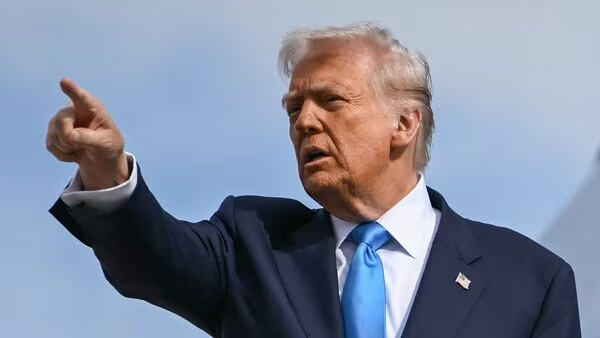
According to News Express, Ogebe said the choice of Sokoto appeared deliberate, noting that the area holds historical significance for the US military following a previous special forces operation carried out during former President Donald Trump’s first term.
He recalled that in 2020, American special forces conducted a daring rescue mission in Sokoto that led to the freedom of a US citizen, Philip Walton, who had been abducted by terrorists. The operation reportedly resulted in the killing of no fewer than six terrorists.
Ogebe described Sokoto as an unusual location for an opening strike, especially as it is not considered the epicentre of global jihadist activity in Nigeria’s North-East, where a deadly suicide bombing was recently recorded in Borno State.
“The North-West appears to be a safer operational bet for the US, given prior boots-on-ground experience and institutional memory from earlier missions,” Ogebe said.
He further explained that Sokoto’s proximity to the Niger Republic where the United States until recently maintained military bases, may also have influenced the decision, as American forces are more familiar with the terrain, intelligence networks and operational architecture in the region.
Meanwhile, the Federal Government of Nigeria has stated that the airstrike operation was conducted jointly with the United States and other international allies.
Ogebe described the government’s claim as credible, referencing lessons from the 2020 Walton rescue mission, which he said nearly failed due to the absence of confirmed clearance to operate within Nigerian airspace.
According to him, such past challenges underscore the likelihood of deeper coordination between Nigerian authorities and foreign partners in any renewed military engagement within the country.