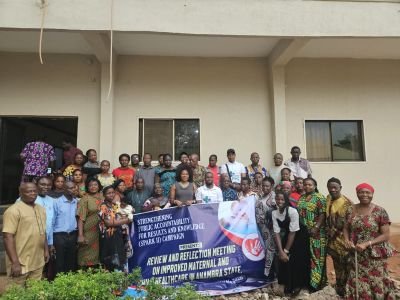
…the Maternal Child Health Review highlighted deliberate efforts to amplify the voices of pregnant women.
AWKA, NIGERIA — The iNews Times | Maternal Child Health Review took centre stage in Awka as stakeholders under the Strengthening Public Accountability for Results and Knowledge (SPARK 2) Project reaffirmed their commitment to tackling high maternal and neonatal mortality through community-driven accountability mechanisms.
The one-day review and reflection meeting brought together implementing partners, community representatives and health sector actors to assess progress made in improving maternal and child health service delivery across Primary Healthcare Centres (PHCs) in Anambra State.
The Maternal Child Health Review focused on consolidating gains recorded under the SPARK 2 Project, which is supported by the International Budget Partnership and implemented in the state by four partner organisations: Justice, Development and Peace Caritas (JDPC) Nnewi, Social and Integral Development Centre (SIDEC), Civil Rights Concern (CRC), and the Community Empowerment Network (COMEN).
Speaking during the engagement, the Executive Director of SIDEC, Ugochi Ehiahuruike, explained that the review meeting was centred on strengthening maternal and child healthcare delivery using facilities funded under the Basic Healthcare Provision Fund as an entry point.
According to her, the gathering provided an opportunity for stakeholders to deepen engagement, evaluate progress and consolidate achievements recorded since the intervention began.
She described the session as more than a routine review, noting that it was a deliberate effort to measure change, assess impact and strategically plan future interventions aimed at reducing maternal and neonatal deaths in the state.
Ehiahuruike disclosed that although the core campaign phase of SPARK 2 ended in December, a three-month extension enabled partners to intensify grassroots engagement and strengthen accountability systems within communities.
“What we are doing here is taking stock, understanding what has worked, what has changed, and what needs to happen next,” she said, stressing that evidence-based reflection remains essential for sustainable health reforms.
A major component of the intervention, she noted, has been capacity building at the grassroots level. Community members, particularly those serving in Ward Development Committees (WDCs), were trained on leadership, transparency, accountability and effective engagement with relevant government actors.
She expressed satisfaction that the empowerment of WDC members has started yielding visible results, especially in tracking health facility performance and ensuring that allocated funds are properly utilised for intended services.
Programme Manager for SPARK at JDPC Nnewi, Onyekachi Ololo, also reaffirmed the commitment of implementing partners to sustain progress achieved so far.
Ololo assured that additional training sessions would be organised for Officers-in-Charge (OICs) of health facilities and Ward Development Committees to strengthen their understanding of their roles in delivering universal health coverage at the primary healthcare level.
He emphasized that the intervention is being implemented in close collaboration with the Anambra State Ministry of Health and the Anambra State Primary Health Care Development Agency (ANSPHCDA), ensuring that policy direction aligns with grassroots accountability efforts.
“We are building the capacity of community members to understand the services that should be available at Primary Healthcare Centres, to track health budgets, and to report gaps to those responsible,” Ololo stated.
He further explained that empowering citizens with knowledge of budget allocations and service standards creates a feedback loop that compels improved performance and responsiveness within the health system.
Beyond institutional collaboration, the Maternal Child Health Review highlighted deliberate efforts to amplify the voices of pregnant women, nursing mothers and persons with disabilities in community health conversations.
Ololo expressed optimism that sustained accountability, combined with strengthened community engagement, would contribute significantly to reducing maternal and neonatal mortality rates in the state.
Health experts have consistently identified weak accountability systems, limited community participation and inadequate monitoring as major contributors to poor maternal and child health outcomes across many parts of Nigeria.
By leveraging community structures such as Ward Development Committees, the SPARK 2 initiative seeks to bridge the gap between policy implementation and service delivery at the facility level.
Observers at the meeting noted that strengthening primary healthcare systems remains critical to achieving improved maternal and child health indicators, particularly in rural communities where access to quality care can be limited.
The Maternal Child Health Review also underscored the importance of sustained government support, transparency in the management of Basic Healthcare Provision Funds, and continuous monitoring to ensure that health facilities are adequately staffed and equipped.
As stakeholders continue to consolidate gains recorded under SPARK 2, attention is now shifting toward ensuring that accountability frameworks established during the intervention are institutionalised beyond the project lifespan.
For many participants, the meeting represented a renewed commitment to collective action in safeguarding the lives of mothers and newborns across Anambra State.
The iNews Times gathered that stakeholders plan to maintain momentum through ongoing monitoring visits, community dialogues and structured feedback mechanisms aimed at sustaining improvements in service delivery.
With maternal and neonatal mortality remaining key public health challenges nationwide, the outcomes of the Maternal Child Health Review may provide a replicable model for strengthening accountability-driven healthcare reforms in other states.