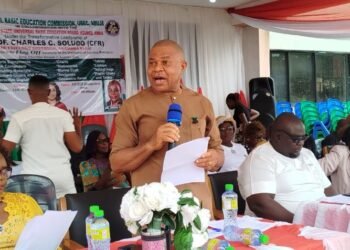
…until her appointment as ASUBEB Chairman, Dr. Anyadiegwu served as Provost of Nwafor Orizu College of Education.
Awka, Nigeria — The iNews Times reports that the appointment of a new ASUBEB Chairman has sparked fresh optimism in Anambra’s education sector, as Governor Chukwuma Soludo named Dr. Justina Chinyere Anyadiegwu to head the Anambra State Universal Basic Education Board.
The announcement, confirmed on Wednesday by the Chief Press Secretary to the Governor, Christian Aburime, positions Dr. Anyadiegwu as the new ASUBEB Chairman tasked with overseeing reforms in the state’s universal basic education system.
The appointment is widely seen as a strategic move by the Soludo administration to strengthen foundational learning across public primary and junior secondary schools in Anambra State.
Until her appointment as ASUBEB Chairman, Dr. Anyadiegwu served as Provost of Nwafor Orizu College of Education (NOCEN), Nsugbe one of the state’s foremost teacher-training institutions.
According to the government statement, she is expected to leverage her over 30 years of teaching, research, and administrative experience to reposition the Universal Basic Education framework in the state.
Dr. Anyadiegwu is a renowned English Language lecturer who has taught at the primary, secondary, and tertiary levels in Nigeria. Her career reflects deep engagement with classroom pedagogy, curriculum development, and teacher capacity-building key pillars for any effective ASUBEB Chairman.
The new ASUBEB Chairman holds a Bachelor of Education degree in Languages Arts/English from Ahmadu Bello University, Zaria. She also earned both her Master’s and Ph.D. degrees in English Language and Literature from Nnamdi Azikiwe University.
An applied linguist, Dr. Anyadiegwu specializes in active learning strategies and inclusive language education areas considered critical in strengthening early-grade literacy and communication skills among pupils.
Education analysts say her background aligns closely with the evolving demands of Nigeria’s Universal Basic Education (UBE) system, which emphasizes phonics, reading fluency, digital literacy, and competency-based learning.
Before emerging as ASUBEB Chairman, Dr. Anyadiegwu worked extensively with the British Council between 2012 and 2014 as a consultant trainer.
During that period, she facilitated training on Content and Language Integrated Learning (CLIL) and the Teaching Knowledge Test (TKT), helping educators adopt global best practices in classroom instruction.
She also served as a Master Trainer under the British Council’s Strengthening Teachers’ English Proficiency (STEP) programme, designed to enhance the quality of English instruction among basic education teachers in Nigeria.
Her involvement in STEP is particularly relevant to her new role as ASUBEB Chairman, as English proficiency remains central to learning outcomes across subjects in Nigerian schools.
The statement further revealed that Dr. Anyadiegwu previously consulted for teacher development programmes organized by the Universal Basic Education Commission (UBEC) in 2012.
In that capacity, she facilitated sessions on Oral English, phonics, and phonemic awareness for Basic Education teachers in Anambra State. These training sessions equipped teachers with practical tools for word recognition, pronunciation, and reading fluency foundational competencies that determine pupil performance in later years.
Education stakeholders believe her direct experience with UBEC initiatives will strengthen coordination between the state board and federal education authorities.
The position of ASUBEB Chairman is crucial in shaping policy direction, teacher recruitment, infrastructure development, and the disbursement of UBE intervention funds.
In recent years, Anambra State has invested heavily in education reform under Governor Soludo’s broader human capital development agenda. The administration has emphasized digital learning integration, teacher retraining, and infrastructural upgrades in public schools.
With Dr. Anyadiegwu now serving as ASUBEB Chairman, observers expect renewed focus on literacy benchmarks, teacher mentoring frameworks, and measurable learning outcomes across the state.
Political observers note that Soludo’s appointment of an academic rather than a career politician as ASUBEB Chairman reflects a governance model prioritizing professional competence and sector expertise.
As Anambra continues to compete nationally in education rankings, the performance of the Universal Basic Education Board will play a defining role in shaping the state’s long-term human capital trajectory.
The iNews Times understands that stakeholders across the education sector, including teachers’ unions, school administrators, and development partners will be closely monitoring the board’s next strategic moves.
For Anambra parents and pupils, however, the central question remains simple: Will the new ASUBEB Chairman translate experience into measurable classroom transformation?