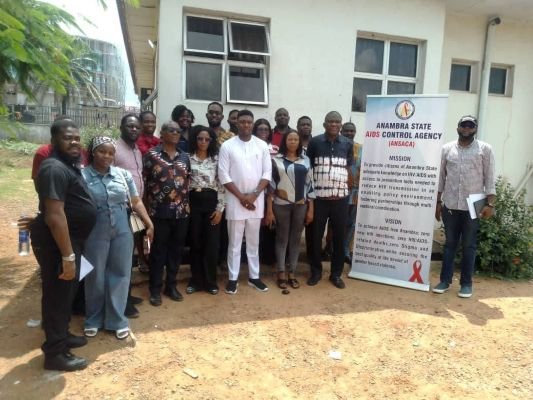
Anambra HIV Surveillance: NACA Tasks State Team on Treatment Access, Viral Suppression.
Agency inaugurates 2026 IBBSS technical team in Awka, pushes for stronger data and epidemic control.
AWKA, NIGERIA – The iNews Times | Anambra HIV Surveillance efforts received renewed momentum as the National Agency for the Control of AIDS (NACA) https://naca.gov.ng charged the state’s Technical Team for the 2026 Integrated Biological and Behavioural Surveillance Study (IBBSS) to intensify identification of persons living with HIV and expand access to treatment to achieve viral suppression.
The directive was issued during the inauguration of the technical team at the 2026 IBBSS state entry meeting held at the Anambra State AIDS Control Agency (ANSACA) in Awka, where federal and state health authorities outlined a coordinated strategy to strengthen HIV epidemic control in the state.
In this report, we examine the key developments, reactions from stakeholders, and the broader implications.
Background of the Story
The Integrated Biological and Behavioural Surveillance Study is a nationally coordinated survey conducted periodically to generate credible data on HIV prevalence, behavioural trends, and treatment outcomes among key populations.
Public health experts consider such surveillance critical to achieving Nigeria’s target of HIV epidemic control by 2030, in line with global commitments.
Anambra State, health officials disclosed, was selected among 12 states for the 2026 survey due to recent structural improvements in its HIV response framework.
Historically, gaps in reliable data have posed challenges for targeted interventions in the state. Officials say strengthening Anambra HIV Surveillance mechanisms is essential to reversing that trend.
Key Developments
Director-General of NACA, Dr. Tope Ilori, who was represented by Mrs. Joy Egwuonwu, Principal Programme Officer of the agency, formally inaugurated the technical team and emphasised the urgency of the assignment.
She urged members to identify persons living with HIV/AIDS, ensure timely access to antiretroviral therapy, and prioritise measurable viral suppression outcomes.
According to her, the IBBSS will generate reliable and actionable data to guide prevention, treatment, and control strategies across Anambra.
Ilori commended Governor Chukwuma Soludo for appointing Dr. Hilary Okeke as Executive Director and Programme Manager of ANSACA, describing him as a vibrant and competent public health professional capable of repositioning the state’s HIV response.
She acknowledged that previous HIV data from Anambra had been weak but expressed optimism that recent leadership changes would strengthen the surveillance architecture.
Dr. Okeke, in his remarks, disclosed that the survey would focus on key populations, including female sex workers, men who have sex with men, and people who inject drugs.
He assured stakeholders that the Soludo administration had created an enabling environment for effective programme implementation and pledged that the technical team would immediately commence the development of operational strategies for a successful survey rollout.
Also speaking at the event, Mr. Chukwuebuka Ejekam, Acting Chief Executive Officer of the West Africa Centre for Public Health and Development, explained that the IBBSS, recommended by the World Health Organisation, is expected to be conducted every three to five years across countries.
He reiterated the organisation’s commitment to supporting Anambra with evidence-based data and programme intelligence to strengthen public health interventions.
Reactions from Stakeholders
Health advocates in the state welcomed the renewed focus on Anambra HIV Surveillance, noting that epidemic control depends heavily on accurate data and sustained treatment access.
A public health consultant who attended the meeting told The iNews Times, “You cannot manage what you do not measure. The surveillance study will show us where the gaps are and where to invest resources.”
Community-based organisations also expressed hope that improved surveillance would reduce stigma and improve service delivery to vulnerable populations.
Dr. Okeke maintained that collaboration among federal agencies, state authorities, and civil society would be crucial in achieving meaningful viral suppression rates.
Implications
The strengthened Anambra HIV Surveillance initiative carries significant public health and policy implications.
First, improved identification of persons living with HIV will enable earlier treatment, reducing transmission rates and improving life expectancy.
Second, achieving viral suppression among patients on antiretroviral therapy is critical to breaking the chain of infection. When viral loads are suppressed, the likelihood of onward transmission drops significantly.
Third, reliable surveillance data will enhance resource allocation, ensuring that donor funding and government investments are directed to areas of greatest need.
For Anambra, which has faced historical data gaps, the 2026 IBBSS represents an opportunity to recalibrate its HIV response strategy and align more effectively with national targets.
What Happens Next
The technical team is expected to begin detailed planning, stakeholder engagement, and field coordination in preparation for data collection.
Health officials indicated that capacity-building sessions and community sensitisation campaigns would precede the survey’s implementation phase.
As the state advances its Anambra HIV Surveillance framework, periodic progress updates are anticipated to ensure transparency and measurable impact.
Observers say the outcome of the survey will shape HIV intervention policies in Anambra for years to come.
Conclusion
The renewed push for Anambra HIV Surveillance underscores the central role of data-driven decision-making in public health governance.
With NACA’s directive and state-level commitment, the 2026 IBBSS offers a strategic opportunity to strengthen treatment access, achieve viral suppression, and move closer to HIV epidemic control.
Whether these ambitions translate into measurable outcomes will depend on sustained coordination, transparency, and community engagement in the months ahead.