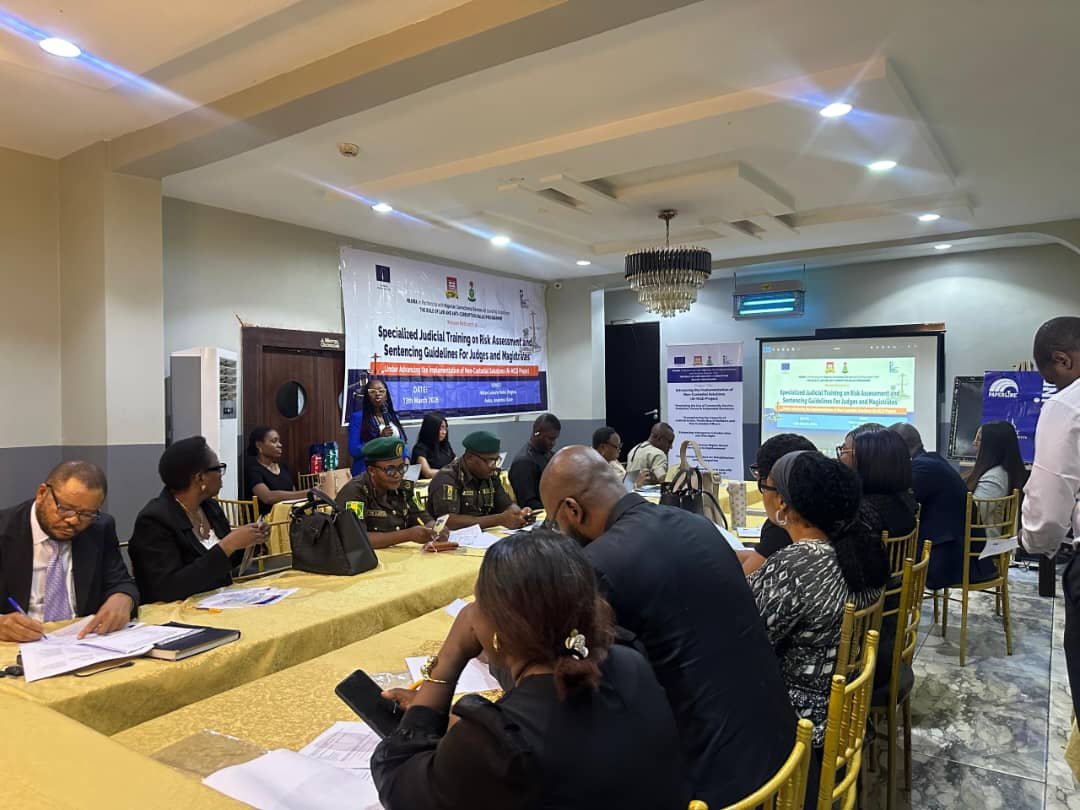
…the training on Non-Custodial Measures Anambra was funded by the European Union.
Awka, Nigeria – The iNews Times | Non-Custodial Measures Anambra received a boost as the Prisoners Rehabilitation and Welfare Action (PRAWA) organised a specialised judicial training for members of the judiciary and Non-Custodial officers of the Nigerian Correctional Service (NCoS) on risk assessment and sentencing guidelines for non-custodial measures.
The training on Non-Custodial Measures Anambra was funded by the European Union through the International IDEA under the Rule of Law and Anti-Corruption Programme (RoLAC) Phase II.
Participants at the training included judges, magistrates, court officials and senior officers of the Nigerian Correctional Service.
Speaking during the exercise, Programme Planning Manager and Team Lead of the Advancing Implementation of Non-Custodial Solutions Project, Chioma Anuna, identified ignorance and public perception as key challenges affecting the effective utilisation of non-custodial measures in Nigeria.
She also cited lack of synergy between the judiciary and officers of the Nigerian Correctional Service, as well as lack of confidence and trust by some judicial officers in using non-custodial sanctions.
Anuna therefore called for increased utilisation of the Non-Custodial Measures Anambra, stressing the need for stronger collaboration between the judiciary and NCoS officers.
“Over time, we discovered that despite the emergence of the Administration of Criminal Justice laws of states and the federal Act, as well as the NCoS Act of 2019, the laws are still not fully and effectively utilised,” she said.
“Among the challenges are lack of awareness, confidence and trust on the part of the judiciary in using non-custodial sanctions. There are also issues of public perception and lack of synergy and collaboration.”
According to her, as gatekeepers of the criminal justice system, the judiciary is expected to issue non-custodial sanctions, without which the Nigerian Correctional Service would have no framework to supervise offenders outside custodial centres.
She said the training on Non-Custodial Measures Anambra was aimed at building the capacity of stakeholders in understanding the objectives, applications and benefits of non-custodial sanctions.
“The training will expose participants to challenges hindering utilisation of the laws and proffer solutions.
“It will also explore ways to strengthen collaboration with the Nigerian Correctional Service to ensure that the use of non-custodial measures is advanced within the criminal justice system.
“We expect that justice delivered through the criminal justice system will be proportionate and rehabilitative, aimed at correcting offenders and not just punishing them,” she added.
Controller of the Nigerian Correctional Service in Anambra State, Ike Anslem, said the training was designed to deepen participants’ collective understanding of the legal foundations of non-custodial sentencing.
Anslem, who was represented by the Command Public Relations Officer, CSC Francis Ekezie, said the programme would also introduce risk assessment tools that support informed judicial decision-making.
He commended judicial officers and partners present at the engagement, describing their participation as a demonstration of strong commitment to strengthening the administration of justice and improving the effectiveness of Nigeria’s criminal justice system.
According to him, the introduction of non-custodial measures under the Nigerian Correctional Service Act 2019 marked a significant milestone in the reform of Nigeria’s correctional system.
“The Act formally established the Non-Custodial Service as a key component of the correctional framework.
“These measures provide practical alternatives to imprisonment, especially for minor and non-violent offenders,” he said.
Anslem noted that non-custodial measures such as community service, probation and other alternatives help reduce congestion in custodial centres while promoting rehabilitation, restitution and the successful reintegration of offenders into society.
However, he stressed that the success of Non-Custodial Measures Anambra depends largely on the confidence and active participation of the judiciary.
He emphasised the critical role of judges and magistrates in determining when non-custodial options should be applied in the interest of justice and societal balance.
Describing the exercise as timely and strategic, the Controller expressed confidence that the discussions would lead to practical outcomes.
He said such outcomes could include improved utilisation of non-custodial sanctions, stronger institutional collaboration and the development of practical action points to support effective implementation of non-custodial measures in the state.
Also speaking, Programme Assistant, PRAWA Edo State, Abraham Naibo, expressed concern over worsening conditions of inmates in correctional centres across the country.
Naibo, a clinical psychologist, attributed the situation to lack of adequate care and poor environmental conditions in correctional facilities.
He called for support from organisations, individuals and other stakeholders to assist government in addressing the problem.
“Currently, about 8,500 inmates are suffering from one form of mental disorder or another which needs urgent attention,” he said.
He emphasised the need for increased support to provide care and medication for affected inmates, noting that government alone cannot handle the challenge.
Naibo also advocated for the recruitment of more professionals such as psychologists, social workers and counsellors to assist inmates requiring specialised care.
He added that inmates, despite their offences, remain human beings with rights and deserve adequate support and rehabilitation.
According to him, many inmates possess valuable skills but are unable to maximise them due to their mental health conditions.
He noted that when properly managed and rehabilitated, such individuals could reintegrate into society and make meaningful contributions after serving their sentences.
State Coordinator of the Rule of Law and Anti-Corruption Programme (RoLAC) and representative of International IDEA, Josephine Onah, said the programme remains committed to initiatives that support inmates and reduce the number of people awaiting trial in correctional facilities.
She expressed concern over the growing population of inmates in custodial centres and emphasised the need for alternatives to incarceration.
“Incarcerating people all the time is not the best option. There is a need for alternatives, including community service, especially for those who commit minor offences,” she said.
According to Onah, such alternatives would not only help rehabilitate offenders but also ensure their smooth reintegration into society.
She expressed optimism that the training would encourage wider utilisation of Non-Custodial Measures Anambra within the criminal justice system.
Onah also commended PRAWA for its partnership with RoLAC, particularly in advancing key thematic areas including criminal justice delivery, access to justice for women, children and persons with disabilities, as well as anti-corruption initiatives.
Judicial officers present at the event included Hon. Justice J.I. Nweze, who represented the Chief Judge of Anambra State, Hon. Justice Onyinye Anumonye, Deputy Chief Registrar Chief Magistrate Vivian Udedike, and the Officer in Charge of the Non-Custodial Unit, Anambra State Correctional Command, ACC Phibina Nneka Ejiofor, among other dignitaries.