…the ADC Youth Protest is scheduled to begin at 8 a.m. at Yaba College of Technology.
ABUJA, NIGERIA — The iNews Times reports that the ADC Youth Protest movement is set to intensify today as youth members of the African Democratic Congress (ADC) stage coordinated demonstrations in Lagos, Ogun and Jigawa states, escalating pressure on the Independent National Electoral Commission (INEC) amid a worsening leadership crisis within the party.
The protests, organised under the trending hashtag #AmupitanMustGo, are expected to take place at INEC offices across the three states. Organisers describe the ADC Youth Protest as a broader campaign demanding accountability, adherence to due process, and clarity over the party’s leadership structure.
The ADC Youth Protest was publicly announced by the party’s National Youth Leader, Balarabe Rufai, who disclosed plans for the coordinated action via X (formerly Twitter). Flyers shared online described the mobilisation as “Operation Occupy INEC,” signalling a sustained campaign rather than a one-off demonstration.
According to Rufai, the Lagos leg of the ADC Youth Protest is scheduled to begin at 8 a.m. at Yaba College of Technology. In Ogun State, demonstrators are expected to converge by 11 a.m. at the Nigerian National Petroleum Company Limited (NNPC) office in Abeokuta. Details regarding the Jigawa gathering were still emerging as of press time.
The organisers insist the ADC Youth Protest will be peaceful, framing it as civic engagement aimed at defending democratic values.
“This is a call for accountability, not chaos,” Rufai said in an earlier statement. He emphasised that the rule of law must be respected in handling the party’s internal disputes.
The ADC Youth Protest stems from a deepening internal leadership dispute that has split factions within the party. Youth members have accused INEC of failing to properly address concerns related to the recognition of party leadership structures.
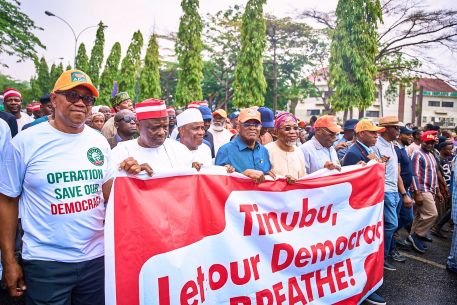
During an earlier protest at the INEC office in Lagos, ADC youths carried placards demanding the resignation of INEC’s chairman, Joash Amupitan, and the restoration of party leadership under David Mark.
Although INEC has yet to issue a detailed public response to the specific demands raised by ADC youths, the situation underscores the complex relationship between political parties and Nigeria’s electoral umpire.
Political analysts note that party leadership disputes often require INEC’s administrative intervention, particularly where questions of authentic executive recognition arise. Such conflicts can have significant implications for candidate nominations ahead of election cycles.
The current ADC Youth Protest follows a broader “Occupy INEC” demonstration held in Abuja on April 8, which drew several prominent opposition figures.
Among those present at that protest were former Vice-President Atiku Abubakar, former Anambra governor Peter Obi, former Kano governor Rabiu Kwankwaso, former Rivers governor Rotimi Amaechi, former Osun governor Rauf Aregbesola, and former Kogi lawmaker Dino Melaye.
That demonstration amplified national attention on electoral transparency and party autonomy. Observers say the ADC Youth Protest now represents a continuation of that pressure campaign, albeit focused specifically on internal party recognition issues.
Under Nigeria’s Electoral Act, INEC plays a crucial role in monitoring party primaries, recognising party executives, and ensuring compliance with constitutional and statutory guidelines.
When disputes arise over leadership or executive committees, factions often seek INEC’s validation to strengthen their legitimacy. Such scenarios can escalate into litigation, parallel congresses, or public demonstrations — as seen in the unfolding ADC Youth Protest.
Experts warn that unresolved leadership disputes can weaken party cohesion and reduce electoral competitiveness, especially as Nigeria gradually approaches future electoral milestones.
The timing of the ADC Youth Protest is politically significant. Youth mobilisation within political parties often signals deeper dissatisfaction among grassroots members.
For the ADC, maintaining unity will be essential in positioning itself as a viable alternative in Nigeria’s multiparty landscape. Internal fragmentation could affect candidate nominations, alliance-building efforts, and public perception.
For INEC, sustained protests may raise broader questions about transparency and communication in resolving party disputes.
Organisers have consistently framed the ADC Youth Protest as peaceful civic engagement. However, security analysts caution that political protests must be carefully managed to prevent infiltration or escalation.
So far, no reports of violence have emerged from previous demonstrations. Law enforcement agencies are expected to monitor today’s gatherings across Lagos, Ogun, and Jigawa states.
As the ADC Youth Protest unfolds, attention will turn to whether INEC responds formally to the demands raised by the party’s youth wing.
Political observers say three possible outcomes may follow; administrative clarification from INEC, legal action by affected party factions, internal reconciliation efforts within the ADC.
The iNews Times understands that party elders are also exploring dialogue channels to de-escalate tensions.
For now, the ADC Youth Protest represents a pivotal moment for the party’s internal democracy and its relationship with Nigeria’s electoral authority.
The iNews Times will continue to monitor developments across the affected states and provide verified updates as events unfold.