…the theme of World Veterinary Day 2026 reinforces the importance of the “One Health.”
Awka, Nigeria — The iNews Times reports that World Veterinary Day 2026 has sparked renewed calls for urgent investment in veterinary infrastructure in Anambra State, as the Nigerian Veterinary Medical Association (NVMA), Anambra Chapter, warned that animal diseases remain a serious threat to human health.
Commemorating World Veterinary Day 2026, the association emphasized the growing danger of zoonotic diseases infections that can be transmitted from animals to humans stressing that “when animals are sick, humans are not safe.”
In a statement issued by the State Chairman of the NVMA, Dr. Victor Ughaerumba, the association listed Avian Influenza, Rabies, Anthrax, Tuberculosis, and Foot-and-Mouth Disease as key animal-borne illnesses posing risks to public health.
According to him, the theme of World Veterinary Day 2026 reinforces the importance of the “One Health” approach a global concept that recognizes the strong connection between animal health, human health, and environmental safety.
“Healthy animals mean healthy people. Safe food means a stronger Anambra. Let this World Veterinary Day be a turning point because in protecting animals, we are protecting ourselves,” Ughaerumba stated.
He explained that veterinary professionals are trained not only to diagnose and treat animal diseases but also to prevent the spread of deadly infections, inspect meat in abattoirs, and safeguard livestock production to ensure food security.
A major concern raised during the World Veterinary Day 2026 commemoration was the absence of a functional veterinary diagnostic laboratory in Anambra State.
Dr. Ughaerumba lamented that without proper diagnostic facilities, veterinarians are often forced to rely on clinical signs rather than confirmatory laboratory testing, a practice that may not always guarantee accurate results.
“When samples require proper testing, they must be transported to other states. This leads to delays in diagnosis and treatment, increased spread of diseases, and greater risk to public health,” he said.
Public health experts note that delayed diagnosis of zoonotic diseases can accelerate outbreaks, especially in densely populated commercial centers like Onitsha, Nnewi, and Awka, where livestock trade and meat processing activities are high.
World Veterinary Day is observed globally every April to recognize the vital role veterinarians play in animal health, food safety, disease prevention, and public health protection.
The COVID-19 pandemic further highlighted the importance of monitoring diseases that originate from animals. Global health bodies continue to stress that early detection and surveillance are crucial in preventing future pandemics.
In this context, World Veterinary Day 2026 serves as a reminder that strengthening veterinary systems is not only about livestock productivity but also about national health security.
The NVMA used the occasion of World Veterinary Day 2026 to urge the Anambra State Government, private sector stakeholders, and development partners to invest in; Standard veterinary diagnostic laboratories, Modern abattoir facilities, Robust disease surveillance systems, Capacity building for veterinary professionals.
The association argued that modern diagnostic laboratories would enable faster confirmatory testing, reduce disease spread, and enhance food safety monitoring across the state.
It also stressed that improved abattoir facilities would ensure proper meat inspection processes, thereby reducing the risk of contaminated animal products reaching consumers.
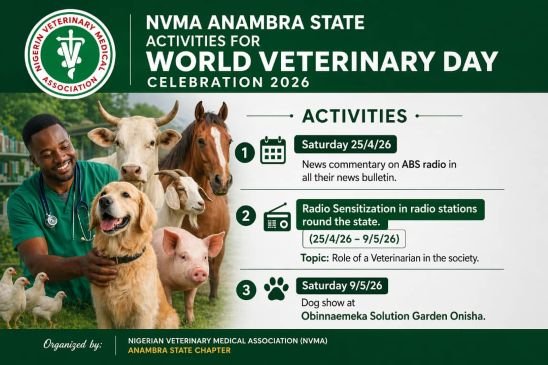
As part of activities marking World Veterinary Day 2026, the NVMA Anambra Chapter announced a series of public enlightenment programs.
These include a news commentary session on Anambra Broadcasting Service (ABS) and a sensitization campaign on the “Role of a Veterinarian in the Society,” scheduled for Saturday, April 25, 2026.
Additionally, a Dog Show will be held at Obinnaemeka Solution Garden in Onitsha on Saturday, May 9, 2026, aimed at promoting responsible pet ownership and raising awareness about rabies prevention.
Veterinary experts stress that rabies remains one of the most deadly yet preventable zoonotic diseases, particularly in developing countries where vaccination coverage among domestic animals may be inconsistent.
The NVMA reiterated that effective disease prevention requires collaboration among medical doctors, veterinarians, environmental experts, and policymakers.
The “One Health” concept, highlighted during World Veterinary Day 2026, recognizes that environmental degradation, climate change, urbanization, and increased human-animal interaction can elevate the risk of disease transmission.
By investing in veterinary science and disease surveillance, authorities can reduce the likelihood of outbreaks that threaten both economic stability and human lives.
As the global community marks World Veterinary Day 2026, stakeholders in Anambra are being urged to treat the moment as a call to action rather than a ceremonial observance.
With increasing awareness of zoonotic threats, experts argue that proactive measures today will prevent costly health emergencies tomorrow.
For residents, farmers, livestock traders, and pet owners, the message remains clear: protecting animal health is a shared responsibility that directly safeguards human well-being.
The iNews Times will continue to follow developments on veterinary infrastructure, zoonotic disease control, and public health initiatives across Anambra State.