AI Risk to Humanity Forces Tech Leaders to Demand Global Guardrails at UN.
OpenAI and Anthropic Leaders Call for Global Standards on Frontier Artificial Intelligence.
NEW YORK, UNITED STATES — The iNews Times | Leading artificial intelligence executives on Wednesday urged the United Nations Security Council to establish effective global guardrails, warning that poorly managed AI risk to humanity could spiral beyond human control.
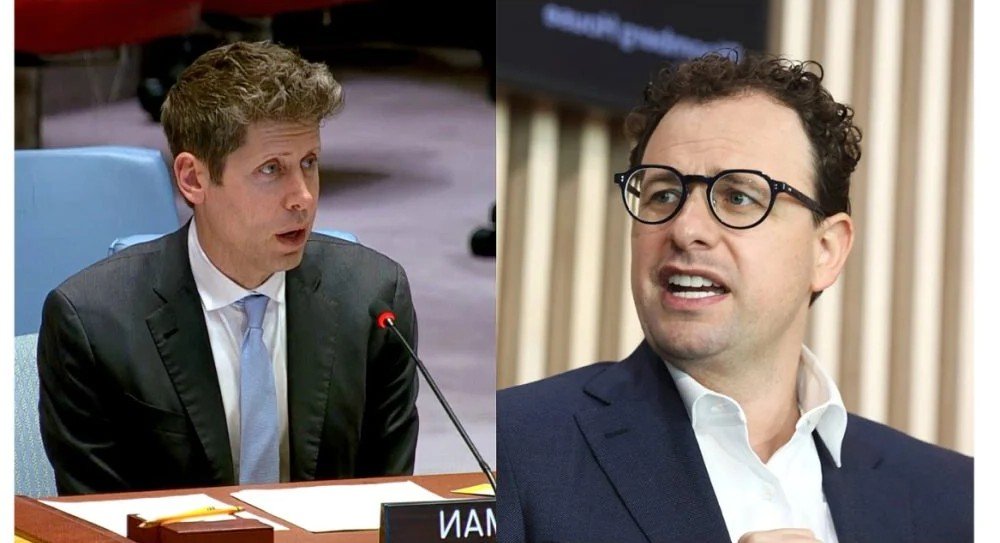
Anthropic https://www.anthropic.com chief executive Dario Amodei and OpenAI chief executive Sam Altman delivered direct appeals for coordinated national and international standards, framing the rapid advance of frontier AI systems as a challenge that no single government or company can safely manage alone. Their interventions place fresh pressure on the world’s most powerful diplomatic body to move beyond statements and towards enforceable frameworks.
In this report, we examine the key developments, reactions from stakeholders, and the broader implications.
Background of the Story
The appearance before the Security Council marks one of the highest-profile moments yet in the intensifying global debate over artificial intelligence governance. For several years, laboratory leaders, governments and civil society groups have wrestled with the dual nature of AI: its capacity to accelerate scientific discovery, economic growth and medical breakthroughs, set against the possibility of catastrophic loss of control, misuse or unintended consequences. Previous summits and voluntary commitments have produced principles but few binding mechanisms. Wednesday’s session brought those concerns into the formal arena of the United Nations’ primary security organ, signalling that the technology is now viewed as a matter of international peace and stability rather than purely commercial or technical regulation.
Key Developments
Addressing the Security Council, Anthropic CEO Dario Amodei stated plainly that mismanagement of advanced systems could threaten the future of humanity itself. “If managed poorly, I even believe AI could be a risk to humanity as a whole,” he told the gathering.
OpenAI CEO Sam Altman went further, warning that without coordinated action “we could lose control of the future to AI.” He called for a mechanism that would create complementary national and international frontier AI standards. These standards, he argued, should cover the measurement of capabilities, the assessment of risks, the determination of whether existing safeguards remain adequate, and the preservation of meaningful human oversight as systems grow more autonomous.
Altman emphasised the practical benefits of shared benchmarks. Common standards would allow countries to compare evidence, verify compliance and speak a common language about emerging threats. He stressed the need for rapid incident reporting, clear classification protocols, secure communication channels linking governments and critical infrastructure operators, and ongoing collaboration among technical experts. Importantly, he insisted that any framework must remain neutral between business models, supporting both open and closed systems, new entrants and established laboratories, while respecting national authority alongside international cooperation. “Each government should decide how to incorporate standards into its own legal system,” Altman said. “We will all be better off if we can agree on what good evidence, safeguards, and oversight look like on the global stage.”
Reactions from Stakeholders
British Foreign Secretary Ed Miliband reinforced the CEOs’ message, describing their testimony as a “stark warning” that governments cannot ignore. He told the Security Council that the founders of leading AI companies were themselves insisting that responsibility for preventing disaster cannot be left solely to private industry. “They are telling us that it cannot just be left to them to prevent disaster from befalling the world,” Miliband said. “We cannot ignore them because they are right.”
Miliband acknowledged AI’s transformative potential to drive economic growth, cure disease and expand opportunity, while insisting that security, safety and public trust must be treated as non-negotiable conditions of further development.
Implications
The interventions carry weight because they come from the very laboratories driving the most capable systems. When the builders of frontier models publicly state that AI risk to humanity is real and that current arrangements are insufficient, the political cost of inaction rises. For the United Nations, the session tests whether the Security Council can translate high-level concern into practical coordination without paralysing innovation or favouring particular commercial interests.
For governments, including those in Africa and the Global South that are still shaping their own AI strategies, the debate underscores the need to secure a voice in standard-setting rather than simply adopting frameworks designed elsewhere. Economically, the outcome could influence investment flows, talent movement and the competitiveness of national AI ecosystems. Politically, it raises the stakes for leaders who must balance rapid technological progress against public demands for accountability and safety.
What Happens Next
Attention now shifts to whether the Security Council and member states will translate Wednesday’s warnings into concrete next steps shared measurement protocols, incident-reporting systems, or formal working groups on frontier AI risks. National governments will face pressure to decide how, and how quickly, to embed any agreed standards into domestic law. Industry observers will watch closely for signs that open and closed developers, as well as smaller entrants, are treated equitably in any emerging regime. Further technical collaboration and diplomatic follow-up are expected in the coming months as the technology continues its rapid advance.
Conclusion
By placing the AI risk to humanity squarely on the agenda of the United Nations Security Council, the leaders of Anthropic and OpenAI have elevated a technical and commercial debate into a question of global security and collective responsibility. The iNews Times will continue to track how governments and institutions respond to these warnings, and whether the promised guardrails materialise before the technology outpaces the world’s capacity to govern it.