Oil prices fall after Trump hails productive Iran talks at UN.
Diplomatic opening sparks brief relief in energy markets amid ongoing Middle East conflict and Saudi export efforts.
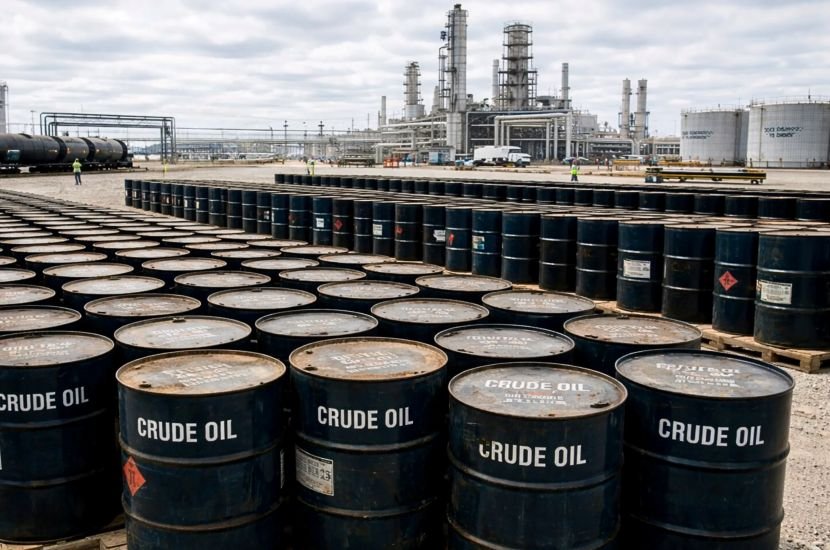
LAGOS, NIGERIA — The iNews Times | Oil prices fall on Wednesday after President Donald Trump described recent US-Iran contacts at the United Nations https://www.un.org as “very good” and “very productive,” offering markets a rare signal of possible de-escalation. International benchmark Brent crude slipped to $98.41 a barrel while West Texas Intermediate eased to $89.23, both moving below the symbolic $100 threshold repeatedly tested since the Middle East conflict intensified earlier this year.
The three-hour meeting, confirmed by Trump in remarks to reporters, marks the first publicly acknowledged high-level contact between the sides in months. Trump noted that another round is already scheduled “in the very near future.” The comments arrived only hours after his sharply worded address to the UN General Assembly, in which he said he faced a “big decision” between striking a deal with Tehran or moving to “annihilate the Islamic Republic and do it quickly.”
In this report, we examine the key developments, reactions from stakeholders, and the broader implications.
Background of the Story
Nearly seven months after joint US-Israeli strikes triggered a wider regional war, the United States and Iran have remained locked in a costly standoff. Tehran has kept the Strait of Hormuz effectively closed to commercial traffic, while Washington has enforced a counter-blockade of Iranian ports. Parallel fighting in Yemen between Saudi-backed government forces and Iran-aligned Houthi militants has disrupted Red Sea shipping lanes, further constraining energy flows from the Gulf.
Oil markets have priced in sustained geopolitical risk for much of the conflict, with prices repeatedly pushing above $100. Trump has repeatedly pledged that crude would decline “as soon as” the United States prevails in the war, yet the absence of direct diplomacy had left traders focused almost exclusively on escalation scenarios.
Key Developments
The US-Iran meeting at the United Nations shifted that narrative, at least temporarily. Markets responded with immediate selling pressure in both Brent and WTI contracts during afternoon Asian trading. Simultaneously, reports emerged that Saudi Arabia is preparing to restart operations on its East-West Pipeline, a vital export route previously halted by drone attacks. According to sources cited by Bloomberg, the kingdom aims to resume loadings later this week.
Saudi Aramco has reportedly informed Asian refiners that crude could soon become available from the Red Sea port of Yanbu. European buyers, however, were told they would not receive allocations for October, underscoring ongoing logistical and allocation constraints.
Beyond energy, Asian equity markets presented a mixed picture. Hong Kong’s Hang Seng Index fell 1 percent to 24,842.87 even as Chinese tech giant Alibaba announced plans to expand overseas data centres targeting Europe and the Middle East. Shanghai’s Composite closed 0.4 percent lower at 3,936.52. South Korea’s Kospi rose 0.9 percent and Taiwan’s Taiex gained 0.8 percent, buoyed by semiconductor strength. European indices opened higher. Traders are also watching Thursday’s expected summit between Trump and Chinese President Xi Jinping, where trade tensions and possible Chinese influence over Iran are expected to feature.
Reactions from Stakeholders
Market analysts described the diplomatic development as meaningful even if incomplete. “The three-hour US-Iran meeting matters because it shifts the market from pure escalation pricing toward a genuine diplomatic process, even if a final deal still looks distant,” said Stephen Innes of Quintex Intel.
Kyle Rodda, senior financial markets analyst at Capital.com, noted the layered significance of the week’s diplomacy: “The higher impact issue will be the war in the Middle East and any support the US can extract from China to use its leverage to sway the Iranians.”
Implications
The modest retreat in oil prices fall offers temporary relief to importers and consumers already strained by elevated energy costs, yet the underlying supply risks remain intact. A sustained reopening of Saudi export routes through Yanbu could ease pressure on Asian refiners, while continued restrictions on European allocations highlight uneven recovery. Any credible progress toward a US-Iran understanding would reduce the geopolitical premium that has dominated pricing since February. Conversely, failure of the next scheduled talks could quickly reverse today’s gains and reassert upward pressure on crude.
The concurrent focus on the Trump-Xi meeting adds another layer. A constructive outcome on trade could support risk appetite across markets, while any hardening of positions risks compounding energy and geopolitical uncertainty.
What Happens Next
Markets will closely monitor confirmation of the follow-up US-Iran meeting and concrete signs that Saudi Arabia successfully restarts Red Sea loadings. Attention also turns to Thursday’s Trump-Xi discussions in Washington, where both trade and Middle East leverage are expected to surface. Energy traders will watch for any fresh statements from the White House or Iranian officials that clarify whether the “very productive” contact can evolve into tangible de-escalation.
Conclusion
Wednesday’s oil prices fall reflects a market willing to price even limited diplomatic openings after months of pure conflict risk. While the path to a durable settlement remains uncertain, the combination of US-Iran contact, Saudi pipeline reactivation efforts, and high-level China diplomacy has introduced a measure of cautious optimism. For The iNews Times readers tracking global energy and geopolitical developments, the coming days will test whether these early signals can translate into lasting relief for oil markets and the wider economy.