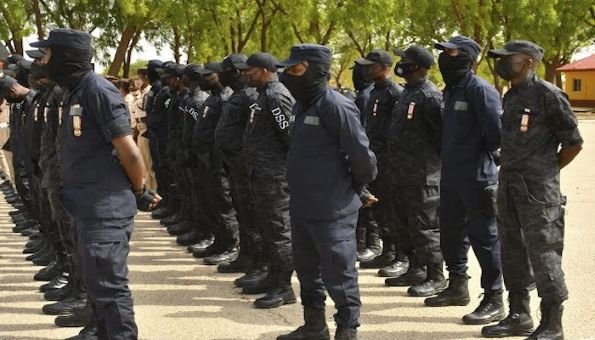
…the Abuja Security Alert has inevitably revived public anxiety surrounding the July 5, 2022 attack on Kuje.
Abuja, Nigeria — The iNews Times | Abuja Security Alert has triggered heightened vigilance across the Federal Capital Territory (FCT) following the circulation of a classified document reportedly attributed to the Department of State Services (DSS) https://www.dss.gov.ng warning of planned coordinated terrorist attacks within the nation’s capital.
The document, which surfaced online and quickly gained traction across digital platforms, allegedly identified high-value targets including the Nnamdi Azikiwe International Airport, the Kuje Correctional Centre, and other sensitive installations across Abuja. Though authorities have not officially confirmed the authenticity of the leaked memo, security deployments have since intensified across strategic locations in the city.
Security agencies including the Nigeria Police Force, Nigeria Immigration Service, and the Nigerian Correctional Service confirmed that preventive measures have been strengthened at airports and custodial centres in response to the emerging threat.
According to the circulating document, the alert followed an internal memo reportedly issued by the Nigeria Customs Service. The memo warned of plans by Islamic State West Africa Province (ISWAP), Boko Haram, Ansaru, and Jama’at Nusrat al-Islam wal-Muslimin (JNIM) to attack critical infrastructure, including the Nnamdi Azikiwe International Airport, the Kuje Custodial Centre, and a military detention facility in Wawa, Niger State.
The document further indicated that ISWAP fighters may have infiltrated parts of the Federal Capital Territory in preparation for coordinated attacks, possibly aimed at freeing detained insurgents.
While the authenticity of the memo remains officially unverified, the operational response on ground suggests that security authorities are treating the Abuja Security Alert with seriousness.
The iNews Times gathered that joint patrols involving police and military personnel have significantly increased in major districts. Stop-and-search operations have been expanded at entry and exit points, transport hubs, and public gathering areas.
Residents report the presence of armed security personnel at key intersections, infrastructure corridors, and around sensitive government facilities. Checkpoints have been reinforced, and patrol vehicles are now more visible during both daytime and nighttime operations.
Officials describe the enhanced security posture as preventive rather than reactive, aimed at deterring potential threats before they materialize.
The Abuja Security Alert has inevitably revived public anxiety surrounding the July 5, 2022 attack on the Kuje custodial facility one of the most significant security breaches in Nigeria’s recent history.
During that coordinated assault, heavily armed attackers breached the facility’s rear perimeter using explosives and sustained gunfire, leading to a mass escape of inmates. Although subsequent nationwide operations led to the recapture of hundreds of escapees, the incident exposed vulnerabilities in security coordination.
Security analysts note that any threat referencing Kuje immediately heightens public sensitivity because of the symbolic and operational implications of a prison break within the nation’s capital.
Reacting to the Abuja Security Alert, two retired senior military officers emphasized the need for disciplined intelligence handling and coordinated inter-agency response.
Retired General Gambo Mai Adua called for vigilance and proactive measures, urging all security agencies to treat the warning with utmost seriousness.
“This is a matter that must be taken seriously. The military, police, DSS, and all relevant agencies must remain vigilant and prepared to respond effectively,” he said.
He highlighted the strategic role of elite units such as the Brigade of Guards, which is responsible for protecting the seat of power, urging them to strengthen operational readiness.
“We are aware that Abuja is protected by specialized units such as the Brigade of Guards. They must rise to the occasion and strengthen their operational posture,” he added.
General Mai Adua also stressed the importance of grassroots intelligence gathering, advising security operatives to integrate within communities to obtain actionable information.
Major General Bashir Galma (Retired), on his part, warned that while intelligence sharing among agencies is critical, improper dissemination of sensitive information could have unintended consequences.
“Inter-agency cooperation is very important, but the way intelligence is communicated to the public must be carefully managed. If not handled properly, it can create panic or even assist those planning attacks,” he said.
He cautioned that uncontrolled public release of operational intelligence may weaken strategic advantage and erode public confidence if not properly explained.
Public reactions to the Abuja Security Alert remain divided.
Mukhtar Ahmad, a trader at Wuse Market, expressed confidence in security agencies, noting that Abuja, as the nation’s capital, receives heightened protection.
“This kind of alert has happened before. Lessons must have been learned, and it is unlikely for such a failure to repeat itself,” he said.
Another resident, Muhammad from Nyanya, urged authorities not to underestimate the situation.
“In the past, warnings were ignored and it resulted in attacks that could have been prevented. Security agencies must not take this lightly,” he stated.
Juliet, a student of the University of Abuja, expressed anxiety about the situation.
“Honestly, I am scared. I just hope security agencies will act quickly to prevent any attack,” she said.
Efforts to obtain official clarification from the Police Public Relations Officer of the FCT Command were unsuccessful as of press time. Security agencies are yet to issue a definitive public statement confirming or dismissing the leaked document.
Experts argue that structured and transparent communication will be critical in managing public confidence. When threat alerts surface, follow-up clarification helps prevent misinformation, panic, and erosion of trust.
The Abuja Security Alert emerges amid ongoing counterterrorism operations across Nigeria’s North-East and North-West regions. As security pressure intensifies in rural strongholds, analysts say insurgent groups may attempt symbolic high-impact operations targeting major cities.
However, proactive surveillance, intelligence coordination, and visible deterrence measures often play a decisive role in neutralizing such threats before execution.
For now, surveillance operations continue to intensify across the Federal Capital Territory.
The iNews Times will continue to monitor developments and provide verified updates as authorities clarify the status of the alleged threat.