Anambra Private Wealth Dominates State Economy, Says Soludo
Governor commissions 1.7km community-funded road, urges residents to embrace PPCP development model.
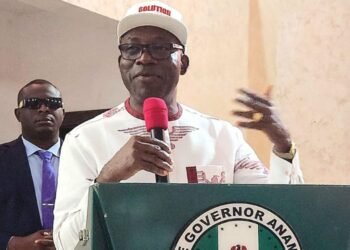
ACHALLA, NIGERIA – The iNews Times | Anambra private wealth took centre stage in Awka North on Thursday as Governor Prof. Chukwuma Soludo declared that about 98 percent of the state’s income and wealth remain in private hands, calling on citizens to stop waiting solely on government for development.
The governor made the assertion during a visit to the ancient kingdom of Achalla, Awka North Local Government Area, where he commissioned a 1.7-kilometre road constructed and paved single-handedly by a prominent indigene, Chief Emma Nwakamma.
In this report, we examine the key developments, reactions from stakeholders, and the broader implications.
Background of the Story
Governor Soludo’s administration has consistently promoted a Private-Public-Community Partnership (PPCP) model aimed at accelerating development through collaboration between government, private citizens and host communities.
The PPCP initiative seeks to leverage Anambra’s strong entrepreneurial base, acknowledging that the state is widely regarded as one of Nigeria’s commercial hubs, with substantial wealth generated by traders, industrialists and professionals both at home and in the diaspora.
Despite infrastructural strides recorded by the state government, Soludo has repeatedly stressed that public resources alone are insufficient to meet the scale of development required.
Key Developments
Speaking before a cheering crowd of residents and stakeholders in Achalla, the governor underscored what he described as a “stark economic reality.”
“About 98 percent of Anambra’s income and wealth is in private hands,” Soludo said. “The government’s budget is only a small percentage of what our people own. To transform Anambra into a liveable and prosperous homeland, we must harness this private wealth.”
He described the newly commissioned road as a “shining beacon” of the PPCP model in action, commending Chief Nwakamma for aligning private success with public responsibility.
According to Soludo, development must be driven not only by government intervention but by a shared civic spirit.
“I celebrate Chief Emma Nwakamma for his heart for the people. But you don’t need to build a kilometre of road to make a difference. Buy a pencil for a child; do the little or much you can give. No one is too poor to give, and no act is too small. Do something for the greater good of the public,” he stated.
The 1.7-kilometre road is expected to improve mobility within the community, facilitate trade and ease transportation for residents.
Reactions from Stakeholders
Chief Emma Nwakamma, the benefactor, said his decision to fund the project was directly inspired by the governor’s PPCP framework.
He expressed confidence that the road would ease the movement of goods and people, stimulate economic activities and improve the overall quality of life in his immediate constituency.
Community members hailed the gesture as a model of patriotic leadership and urged other affluent indigenes to emulate the initiative.
During the visit, Governor Soludo also addressed a lingering leadership crisis within Achalla, assuring residents that the state government would intervene to restore stability.
“We will intervene in the leadership of Achalla to bring about lasting peace. Achalla, are you ready?” he asked.
“Development can only thrive in an atmosphere of tranquility, and our goal is to ensure that Achalla moves forward as one united family.”
The governor further thanked the community for its electoral support, noting that he secured 73 percent of the total votes cast in the area during the election.
Implications
The emphasis on Anambra private wealth carries far-reaching implications for governance and economic strategy in the state.
By publicly acknowledging that government controls only a fraction of the state’s financial capacity, Soludo is effectively shifting part of the development burden to affluent citizens and corporate actors.
Analysts say this approach could unlock significant grassroots investment if properly coordinated, particularly in road infrastructure, education, healthcare and community projects.
However, the model also raises questions about sustainability and equitable development. Without clear coordination frameworks, private-led projects may remain unevenly distributed, benefiting some communities more than others.
Politically, the message reinforces Soludo’s narrative of shared responsibility while positioning his administration as a facilitator rather than sole financier of development.
What Happens Next
The state government is expected to deepen implementation of the PPCP model by encouraging more structured partnerships across local government areas.
Observers anticipate further community-driven projects as wealthy indigenes respond to the governor’s appeal.
Meanwhile, the promised intervention in Achalla’s leadership crisis will likely unfold through dialogue and mediation aimed at restoring unity.
The iNews Times will continue to monitor how the administration translates the rhetoric of Anambra private wealth into measurable development outcomes across the state.
Conclusion
Governor Soludo’s assertion that 98 percent of Anambra’s income lies in private hands underscores a bold recalibration of development philosophy.
As Achalla celebrates its new community-funded road, the broader question remains whether citizens across the state will answer the call to convert private prosperity into collective progress.
For Anambra, the path to a liveable and prosperous homeland may well depend on how effectively public vision meets private capacity.