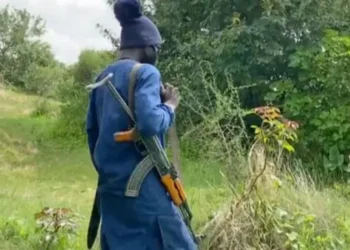
Ansaru terrorists planned Oriire school abductions with Al-Qaeda support, Abuja court hears.
Witness links group’s May 2026 attacks in Oyo State to demands for release of jailed leaders as trial of five suspects continues in Abuja.
ABUJA, NIGERIA — The iNews Times | A prosecution witness told a Federal High Court in Abuja on Monday that Ansaru terrorists, with support from the international network Al-Qaeda, carefully planned the May 15, 2026, attacks on schools in Oriire Local Government Area of Oyo State. The operation was designed to pressure the Federal Government into freeing senior members of the group already in custody.
The five defendants facing trial over alleged involvement in the Oriire incidents are Mahmud Muhammad, also known as Abu Bara’a or Abbas Mukhtar; Abubakar Abbas, also known as Isah Adam or Mallam Mahmuda Al-Nigeri; Abdulrazak Umar, also known as Abu Khalifa or Abu Khalid; Yunusa Musa, also known as Abu Yunusa Bin Musa; and Shamsu Adamu Sani, also known as Abu Itisar. Prosecutors say the men hail from Okene in Kogi State, Daura in Katsina State, and Suleja in Niger State.
In this report, we examine the key developments, reactions from stakeholders, and the broader implications.
Background of the Story
Ansaru, formally known as Jama’atu Ansarul Muslimina fi-Biladis Sudan, emerged after a split from Boko Haram in 2012. According to the witness identified only as BBB, the first defendant, Mahmud Muhammad, was among the early figures who left the larger insurgent group to form Ansaru. Muhammad, whose father is from Okene in Kogi State and whose mother is from Borno State, had previously served as head of security and intelligence for Boko Haram in Maiduguri.
The group’s ideology focused on establishing Islamic governance in Nigeria and targeting foreign nationals, whom members accused of harming Muslims abroad. In 2014, Ansaru’s killing of seven foreigners prompted the United States to designate the organisation a terrorist group and place Muhammad on its most-wanted list. Over the years the group has been linked to high-profile kidnappings, ambushes on security forces, and efforts to free detained leaders through violence.
Key Developments
Led in evidence by the Director of Public Prosecution of the Federation, Oyedepo Rotimi, SAN, the witness told the court that Muhammad later assumed leadership of Ansaru and appointed the second defendant, Abubakar Abbas, as head of operations. The witness detailed a pattern of attacks aimed at securing the release of arrested commanders.
One such operation targeted the convoy of House of Representatives member Jafaru Mohammed Ali on November 4, 2025. Four military personnel were killed and four Department of State Services DSS https://www.dss.gov.ng officers injured. The attackers had hoped to abduct the lawmaker and use him as leverage. A subsequent plan to storm the Wawa military base in New Bussa, Niger State, failed. After that setback, Ansaru members shifted focus to the South-West, calculating that media attention there would amplify their demands.
The Oriire attacks followed this strategy. Students and teachers were abducted and moved to a forest near the Old Oyo National Park. The terrorists then submitted a list of 30 names, including their jailed leaders, and threatened to kill the captives unless the Federal Government released them. When authorities refused to negotiate, the group killed two of the victims and fired on approaching security forces, slaughtering one captive in an attempt to deter rescue efforts.
Security agencies eventually mounted an offensive that freed the remaining hostages. The operation came at a cost: a senior police officer, an Army officer, and the two murdered civilians lost their lives. The witness said the third, fourth, and fifth defendants maintained communication with the commanders holding the Oriire victims and acted in furtherance of the ideology set by the first two defendants.
Reactions from Stakeholders
The prosecution has presented the testimony as evidence of a deliberate campaign by Ansaru terrorists to force the hands of the Nigerian state. No defence responses were detailed in Monday’s proceedings, which remain part of an ongoing trial. The witness emphasised that the group’s hostility and history of killing captives left security forces with little choice but to act.
Implications
The revelations underscore the persistent threat posed by Ansaru even after the arrest of senior figures. The alleged Al-Qaeda connection raises questions about external support for local terrorist cells and the group’s ability to relocate operations across regions. For communities in Oyo State and the wider South-West, the attacks highlighted vulnerabilities in school security and the human cost of non-negotiation policies. Politically, the case tests the Federal Government’s resolve to refuse ransom or prisoner exchanges while demonstrating the operational capacity of security agencies to recover victims under fire.
What Happens Next
Further hearing was scheduled to resume on October 13 before Justice Salim Ibrahim. The trial of the five men continues, with the prosecution expected to present additional evidence linking the defendants to the planning and execution of the Oriire operation and earlier attacks. Security forces remain on alert for any residual Ansaru activity, particularly attempts to free detained leaders through further violence.
Conclusion
The court testimony lays bare a calculated strategy by Ansaru terrorists to use mass abductions as political leverage, backed by international extremist networks. As the trial proceeds in Abuja, the case serves as a stark reminder that the fight against groups seeking to impose their ideology through fear and bloodshed remains unfinished. The iNews Times will continue to follow developments closely as justice seeks answers for the victims of Oriire and the families still mourning those who never returned.