Oriire School Abduction: DSS Witness Describes Feeding Conditions and Trauma in Ansaru Trial.
Survivor details trauma of 56-day ordeal as trial of five alleged Ansaru members continues in Abuja.
ABUJA, NIGERIA — The iNews Times | A Department of State Services (DSS) https://www.dss.gov.ng witness in the ongoing trial of five alleged members of the Ansaru terror group on Friday told the Federal High Court in Abuja that during the Oriire school abduction the captives were fed only when it suited their abductors, even with toddlers as young as 18 months among them.
The witness, code-named AAA for security reasons and herself a victim of the May 15, 2026 attack on schools in Oriire Local Government Area of Oyo State, described the group’s 56-day captivity as deeply traumatising both during and after the ordeal. The testimony came under cross-examination by defence counsel Bala Dakum as the prosecution presses its case against the suspects linked to the abduction and the beheading of two teachers.
In this report, we examine the key developments, reactions from stakeholders, and the broader implications.
Background of the Story
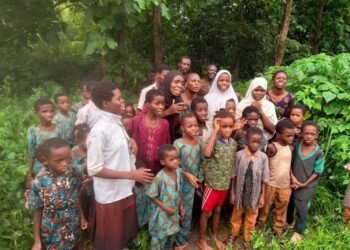
The Oriire school abduction remains one of the most harrowing incidents of school-targeted terrorism in southwestern Nigeria in recent years. On May 15, 2026, armed men believed to be linked to the Jama’atu Ansarul Muslimina fi-Biladis Sudan (Ansaru) invaded Community Grammar School, Baptist Nursery/Primary School and L.A. Primary School in communities including Esinele, Yawota and Alawusa. They carted away approximately 39 pupils and seven teachers, later moving the hostages through six different forest camps while forcing them to walk barefoot and sleep on grass exposed to rain and sun.
The group made clear their motive was not primarily ransom but the release of detained Ansaru commanders. Two teachers, Michael Oyedokun and Deacon John Olaleye, were subsequently beheaded after the abductors claimed the government was not taking their demands seriously. The remaining captives were eventually rescued by security operatives after 56 days. The five defendants now on trial Mahmud Muhammad (aka Abu Bara’a/Abbas Mukhtar), Abubakar Abbas (aka Isah Adam/Mallam Mahmuda Al-Nigeri), Abdulrazak Umar (aka Abu Khalifa/Abu Khalid), Yunusa Musa (aka Yunusa Bin Musa) and Shamsu Adamu Sani (aka Abu Itisar) face terrorism-related charges connected to the incident. Some of them had earlier received life sentences in related proceedings, prompting the DSS to pursue fresh charges over the Oriire school abduction and the killings.
Key Developments
Testifying before Justice Salim Olasupo Ibrahim, witness AAA told the court that food was provided strictly at the convenience of the abductors despite the presence of very young children. She confirmed that the captors used the victims’ mobile phones to contact government officials but said she did not know the numbers called.
AAA further stated that after the rescue she was interrogated by DSS operatives both at their office and while in hospital. She identified three of the five defendants as having been present with the hostages in the forest; she only came to know the other two during the DSS interrogation. Regarding the killings, she said Michael Oyedokun was killed at Camp A and John Olaleye at Camp B, but emphasised she was not present at the scenes of the beheadings and therefore could not identify the specific individuals who carried them out.
The court has fixed October 12 and 13 for the continuation of the trial.
Reactions from Stakeholders
Defence counsel Bala Dakum subjected the witness to detailed cross-examination, focusing on the conditions of captivity, the use of phones for contact with officials, and the identification of the defendants. The prosecution, led by the Director of Public Prosecutions of the Federation, has maintained that the evidence, including survivor testimony, establishes the defendants’ roles in the terrorism offences. Security sources and previous court records have described the Oriire school abduction as a calculated attempt by Ansaru elements to pressure the government into releasing high-profile detained members.
Implications
The testimony sharpens public understanding of the calculated cruelty involved in the Oriire school abduction and underscores the continuing threat posed by Ansaru and its affiliates even in parts of the country previously considered less vulnerable to large-scale school raids. It also highlights the challenges of securing convictions in complex terrorism cases where survivors carry lasting trauma and where key events, such as the beheadings, may not have been directly witnessed by all victims. For families of the slain teachers and the rescued captives, the proceedings represent a critical step toward accountability. Nationally, the trial reinforces the need for sustained intelligence-driven operations and improved protection of educational institutions.
What Happens Next
Justice Salim Olasupo Ibrahim has adjourned further hearing to October 12 and 13. The prosecution is expected to call additional witnesses while the defence continues its cross-examination strategy. The five defendants remain in DSS custody. Outcomes in this case could influence how future terrorism prosecutions involving school abductions are handled and may affect any pending appeals related to earlier life sentences handed to some of the same individuals.
Conclusion
The account given by the DSS witness in the Oriire school abduction trial lays bare the deliberate hardship inflicted on schoolchildren and teachers during their prolonged captivity. As the Federal High Court in Abuja continues to hear the matter, the proceedings serve as both a pursuit of justice for the victims and a reminder of the persistent security challenges facing Nigeria. The iNews Times will continue to follow developments closely as the trial progresses.