…On the ongoing political tension in Rivers, Fayose stated, “President Tinubu will not sacrifice Minister Nyesom Wike for Governor Fubara
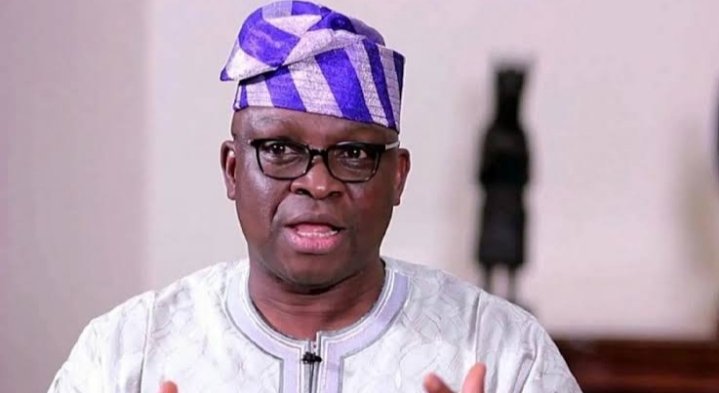
RIVERS, NIGERIA– The iNews Times | Former Ekiti State Governor, Ayo Fayose, has sparked fresh controversy by questioning the political leadership claims of Governor Siminalayi Fubara of Rivers State. The remarks follow Fubara’s public declaration of himself as “001” on the All Progressives Congress (APC) membership register in his ward, a move that has divided opinions among political stakeholders, civil society organizations, and party operatives.
Fayose Challenges Fubara’s Leadership
In an interview on Arise TV, Fayose drew parallels between Rivers and Lagos states, arguing that just as Governor Babajide Sanwo-Olu cannot claim political leadership of Lagos State, Fubara’s claim to be APC leader in Rivers is questionable. Fayose insisted that authority resides with national leaders, citing President Bola Tinubu as the ultimate arbiter in Lagos politics.
On the ongoing political tension in Rivers, Fayose stated, “President Tinubu will not sacrifice Minister Nyesom Wike for Governor Fubara. Wike’s relevance to the party and the President is far greater than Fubara’s. This is politics, and it is about performance and influence, not merely office-holding.”
Rivers APC Reacts: Beke, Enyi Push Back
Fayose’s remarks quickly drew responses from local APC figures. Chief Emeka Beke, factional chairman of the Rivers APC, described Fayose’s statement as baseless. “Fayose is not from the state and he cannot speak on Rivers politics. Fubara is the governor and the 001 of APC in the state,” Beke said.
Similarly, Mr. Chizy Enyi, Coordinator of Initiative for Transparent Strategy and Good Leadership, said Fayose was speaking in defense of Wike, urging him to focus on his relationship with the minister instead of meddling in Rivers politics. Enyi emphasized that Fubara, as governor, remains the de facto political leader of the state, just as President Tinubu is at the national level.
IPAC Faults Wike’s ‘Rainbow Coalition’ Claim
The Inter-Party Advisory Council (IPAC) weighed in, rejecting Wike’s claims that political parties nationwide are aligning under his leadership in a so-called “rainbow coalition” to support President Tinubu’s 2027 re-election. IPAC described the assertion as misleading, stressing that political parties operate independently and make decisions according to their constitutions and internal processes.
However, IPAC acknowledged that some parties are voluntarily considering giving unconditional solidarity support to Fubara by not fielding candidates in Rivers State, a move aimed at promoting stability and continuity of governance.
Impeachment Drama Escalates
The political crisis intensified last week when 26 of the 32 members of the Rivers State House of Assembly, most loyal to Wike initiated impeachment proceedings against Governor Fubara. The move has been met with mixed reactions. Groups including the Pan Niger Delta Elders Forum (PANDEF), Rivers APC, and PDP have called on the lawmakers to drop the proceedings, warning that such actions could destabilize the state.
National Dynamics: Fayose Cites Tinubu’s Influence
Fayose cited Vice President Kashim Shettima’s earlier remarks that defecting PDP governors automatically become APC leaders in their states, pointing to examples in Enugu, Bayelsa, Borno, and Akwa Ibom. He noted that Shettima’s silence on Lagos supported his argument that party leadership is not merely a function of office-holding.
He also highlighted Tinubu’s influence in Lagos, citing the impeachment and reinstatement of House Speaker Mudashiru Obasa as proof of the President’s control over political processes.
Regarding the emergency rule declared in Rivers State, Fayose described it as a political lifeline for Fubara, suggesting the governor’s actions reflect necessity rather than authority.
Fubara’s Defection and the “001” Declaration
Governor Fubara formally defected from the PDP to the APC in December 2025. At the event, he publicly declared himself “001” in the party register, affirming loyalty to President Tinubu and the ruling party. Wike, however, dismissed the claim, noting that APC registration is organized at ward and local government levels and that no statewide “001” exists. He argued that leadership is earned through influence and party performance, not just holding office.
Fayose on Wike and the PDP
Fayose argued that Wike remains politically more relevant to Tinubu than Fubara, citing the minister’s performance in Abuja and his role in delivering electoral victories for the APC. He also criticized the PDP’s internal crisis as self-inflicted, describing the party as “a house divided against itself” due to internal factionalism and conflict.
A former APC National Working Committee member advised Wike to focus on national leadership rather than state-level politics, noting that his role as a national figure transcends Rivers State.
The Road Ahead
The controversy underscores a broader struggle over party leadership in Rivers State and highlights tensions between state and national political structures in Nigeria. Analysts warn that the ongoing rift within the APC, coupled with the impeachment threat, could have significant implications for political stability in the lead-up to the 2027 general elections.
As debates intensify across political, civil society, and media platforms, the resolution of Rivers APC’s leadership crisis will be closely watched as a bellwether for party cohesion and governance in the region.