…the Tesla Cybercab production announcement comes just one day after Tesla reported stronger-than-expected first-quarter earnings.
AUSTIN, UNITED STATES — The iNews Times reports that Tesla Cybercab production has officially commenced, marking a major milestone in the global race toward fully autonomous transportation.
Chief Executive Officer Elon Musk made the announcement on Friday via a post on X, sharing a promotional video and confirming that the long-awaited robotaxi, known as the Cybercab, has entered the production phase.
The 38-second video, filmed largely from inside the driverless vehicle, shows the futuristic car rolling off the factory line and transitioning smoothly onto public roads. The clip offers a rare, close-up glimpse into Tesla’s bold vision for a steering-wheel-free, pedal-less urban transport system.
In a separate post, Musk shared another short video featuring a fleet of gold-coloured Cybercabs travelling in coordinated formation along a roadway, signalling not only production readiness but also Tesla’s ambition to deploy the vehicles at scale.
The Tesla Cybercab production announcement comes just one day after Tesla https://www.telsa.com reported stronger-than-expected first-quarter earnings, posting profits of $477 million. The financial boost appears to have strengthened investor confidence as the company doubles down on autonomous mobility.
Earlier in the week, Tesla reiterated that it remains on schedule to begin mass production of both the Cybercab and the Tesla Semi later this year, signaling a broader push beyond passenger electric vehicles into commercial and autonomous transport sectors.
Industry analysts say the timing of the Tesla Cybercab production announcement is strategic. With increasing competition from autonomous driving firms in the United States and China, Tesla is under pressure to prove that its Full Self-Driving (FSD) software can deliver fully driverless operations at scale.
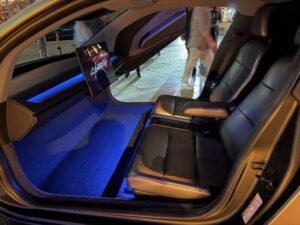
Unlike Tesla’s current lineup of vehicles, the Cybercab is designed from the ground up as a fully autonomous robotaxi. It does not include a steering wheel or pedals, a design choice that underscores Musk’s confidence in Tesla’s AI-powered driving system.
The Cybercab was first unveiled in 2024, with Musk projecting a potential market debut by 2027. The vehicle is expected to operate within a dedicated Tesla ride-hailing network, allowing owners or fleet operators to generate revenue by deploying their cars autonomously when not in personal use.
This production milestone suggests that Tesla is accelerating its roadmap, potentially bringing forward commercial deployment timelines if regulatory approvals align.
Tesla has already taken early steps toward rolling out its robotaxi ecosystem. In June last year, the company launched a limited, invitation-only robotaxi service in Austin, Texas. That pilot programme allowed select users to experience Tesla’s autonomous ride services in controlled conditions.
In February, Tesla released an image showing employees gathered around the first Cybercab to roll off its Texas production line, signaling early manufacturing progress before Friday’s public confirmation.
Observers believe the Tesla Cybercab production phase could pave the way for expanded pilot programmes in additional cities before full commercial rollout.
Despite the excitement surrounding Tesla Cybercab production, significant regulatory challenges remain. Autonomous vehicles must meet strict safety and compliance standards in every jurisdiction where they operate.
In the United States, federal and state regulators continue to scrutinize self-driving technologies amid ongoing debates about safety oversight, liability, and ethical AI decision-making. Tesla’s Full Self-Driving software has faced both praise for innovation and criticism over safety incidents involving driver-assist features.
For international markets, including Europe and parts of Asia, regulatory approval processes could further shape the timeline for global expansion.
The global autonomous vehicle market is projected to reach hundreds of billions of dollars in the coming decade. If Tesla successfully deploys its Cybercab fleet at scale, it could transform urban mobility, reduce private car ownership, and disrupt traditional ride-hailing giants.
Musk has repeatedly described autonomous ride-hailing as a potential trillion-dollar opportunity for Tesla, arguing that robotaxi networks could eventually generate more revenue than the company’s vehicle sales business.
With Tesla Cybercab production now underway, investors will be closely watching manufacturing volumes, software performance metrics, and regulatory approvals to assess whether Tesla can convert ambition into sustained profitability.
While the Cybercab is currently focused on U.S. deployment, its implications are global. Countries with rapidly growing urban populations including Nigeria are observing developments in autonomous transport technology as part of long-term smart city planning.
Although widespread adoption in Africa may still be years away due to infrastructure and regulatory constraints, Tesla’s progress sets a technological benchmark that could influence future mobility policies worldwide.
The immediate focus following Tesla Cybercab production will be scaling output and expanding testing operations. If Tesla meets its mass production targets later this year, it would represent one of the most significant advances in autonomous vehicle commercialization to date.
For now, Musk’s announcement signals that the concept phase is over and the manufacturing phase has begun.
The iNews Times will continue to monitor Tesla Cybercab production developments, regulatory responses, and market reactions as the global race toward fully autonomous mobility intensifies.