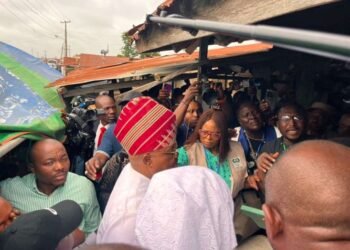
…Ifemeludike described the low number of women occupying political offices in Nigeria as unacceptable.
AWKA, Nigeria — The iNews Times | Chioma Ifemeludike, candidate of the African Action Congress (AAC) in the November 8 governorship election in Anambra State, has challenged women in the state to contest elective positions, insisting they possess the capacity to lead.
Chioma Ifemeludike gave the charge during a one-day Leadership Development Workshop organised by the Social and Integral Development Centre (SIDEC) for aspiring women and persons with disabilities (PWDs) leaders in the state.
The workshop formed part of SIDEC’s Inclusive Mobilization for Participation, Advocacy, and Civic Transformation (Project IMPACT), implemented in partnership with the Nigeria Civil Society Situation Room and supported by the United Kingdom Foreign, Commonwealth and Development Office (FCDO).
Addressing participants, Chioma Ifemeludike said if she, as a woman, could contest against an incumbent governor, Prof. Chukwuma Soludo, Prince Nicholas Ukachukwu of the All Progressives Congress (APC), and several other male candidates in the governorship race, then nothing should stop other women from aspiring to elective offices.
She identified courage, integrity and a clear sense of purpose as the key values that sustained her throughout the electoral process.
Reflecting on her political journey, Chioma Ifemeludike, who is also Deputy National Chairperson (South-East) of the AAC, admitted that the journey was challenging and at some point she almost withdrew from the race.
“At some point, it was as if I could not continue. But thank God I succeeded in getting to the end. There are so many lessons I learnt from the experience which have further sharpened me for the future,” she said.
Speaking on the “Open Seat Bill,” formally known as the Special Seats Bill or Reserved Seats for Women Bill aimed at increasing women’s representation in the National and State Assemblies, Ifemeludike described the low number of women occupying political offices in Nigeria as unacceptable.
She called on women across the country to mobilise support to ensure the bill is passed ahead of the 2027 general elections.
“Reserved seats for women are an honour. Women occupy less than five percent of seats in the current National Assembly, which is among the lowest in Africa. This is unacceptable.
“There is a need for intense advocacy to meet up with the Independent National Electoral Commission (INEC) timetable for the 2027 general elections.
“We also need media participation and strong affiliations to ensure our voices are heard. There should be protests and rallies at the National Assembly by women’s rights groups, activists and stakeholders,” she added.
In another presentation, the lawmaker representing Onitsha North I Constituency in the Anambra State House of Assembly, Mimi Azikiwe, urged women to challenge societal expectations that often confine them to domestic roles.
“Women need to tell themselves the truth. We are often treated as second-class citizens because society was structured to favour men. But beyond those expectations, we are individuals with dreams and aspirations.
“Being women, wives, sisters and daughters does not stop us from becoming business leaders, millionaires or powerful politicians.
“We must dismantle structural barriers such as limited access to funding, weak political networks and cultural attitudes that discourage women from contesting leadership positions.
“Women must deliberately build networks, seek mentorship and develop the confidence required to compete effectively in politics and other leadership spaces,” she said.
Azikiwe also stressed the importance of including persons with disabilities in governance, noting that many of them possess the capacity to contribute meaningfully to public leadership if given the opportunity.
Media consultant Ify Unachukwu, in her presentation titled “Success Stories of Women in Elective and Appointive Positions in Nigeria,” highlighted the achievements of notable Nigerian women who have made significant contributions to governance and public service.
She referenced figures such as Margaret Ekpo, whose activism helped lay the foundation for women’s political participation in Nigeria.
She also cited Dora Akunyili, former Director-General of the National Agency for Food and Drug Administration and Control (NAFDAC), who led major reforms against counterfeit drugs and restored public confidence in Nigeria’s pharmaceutical sector.
Unachukwu further mentioned Ngozi Okonjo-Iweala, former Minister of Finance and current Director-General of the World Trade Organization, for her role in securing Nigeria’s historic debt relief and promoting fiscal transparency.
Other women leaders she highlighted included Virginia Etiaba, Nigeria’s first female governor, and Uche Ekwunife, known for her legislative contributions and constituency development initiatives.
Earlier, Executive Director of SIDEC, Ugochi Ehiahuruike, said the workshop was designed to equip women and persons with disabilities with the skills and confidence needed to actively participate in governance and decision-making processes.
According to her, the initiative forms a key component of Project IMPACT, which aims to increase the participation of women, youth and persons with disabilities in governance across Anambra and Imo states.
She explained that the project focuses strongly on grassroots engagement, particularly within market communities where a large number of eligible voters are concentrated.
“A key component of the project is engagement with communities and markets, building on SIDEC’s inclusive governance work across Anambra’s 158 structured markets where large numbers of eligible voters, particularly women and young people who make up most traders, apprentices and market workers are concentrated,” she said.
Ehiahuruike added that leadership development workshops were being organised in selected markets to strengthen leadership capacity and encourage more women and persons with disabilities to take up leadership roles in their communities and political spaces.
She also emphasised the importance of developing conceptual, technical and social skills for effective leadership.
“In a diverse world, inclusive leadership is essential. Inclusion means creating an environment where everyone can express themselves, contribute their views and feel that those views are valued,” she added.
The workshop also featured goodwill messages from key stakeholders, including the Permanent Secretaries of the Anambra State Ministries of Women Affairs and Agriculture, Chinwe Achugbu and Ify Uzoka, as well as leaders of various women’s groups, including market women and smallholder farmers.