…Pension, Welfare debate heats up in Abia as PDP Chieftain insists no worker should earn below N120,000.
Policy proposal targets wage increase, pension restoration, and financial accountability ahead of political realignment.
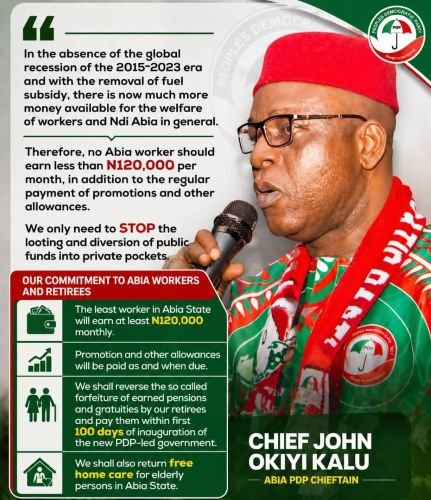
UMUAHIA, NIGERIA — The iNews Times | No Worker Should Earn Below N120,000 has become the rallying call of a Peoples Democratic Party (PDP) https://peoplesdemocraticparty.com.ng chieftain in Abia State, Mr. John Okiyi Kalu, who is demanding a sweeping reform of workers’ welfare and fiscal management in the state.
In a strongly worded policy statement circulated in a flyer, Kalu argued that the current economic realities, particularly post-subsidy fiscal restructuring now provide sufficient revenue headroom for improved workers’ compensation. According to him, the issue is no longer lack of funds but how public resources are managed and prioritized.
In this report, we examine the key developments, reactions from stakeholders, and the broader implications.
Background of the Story
Abia State, like many subnational governments in Nigeria, has faced persistent challenges surrounding salary payments, pensions, gratuities, and workers’ morale. The removal of fuel subsidy by the Federal Government significantly increased allocations to states, triggering renewed debate over how these additional revenues should be deployed.
Kalu referenced the economic constraints of the 2015–2023 period, describing it as an era shaped by global recessionary pressures and tighter fiscal conditions. He argued that the present financial climate offers an opportunity to reset priorities.
He insisted that the principle that No Worker Should Earn Below N120,000 after tax must guide any serious reform agenda in the state.
Key Developments
In his proposal, Kalu declared that under a PDP-led administration, no worker in Abia State would earn below N120,000 monthly after tax deductions. He emphasized that the proposed figure is not symbolic but would be backed by structural reforms aimed at eliminating financial leakages.
He further pledged that promotions would be implemented promptly and that all allowances due to workers would be paid without delay. According to him, the objective is to restore dignity to the public service and rebuild confidence within the workforce.
Beyond active workers, Kalu extended the reform framework to retirees. He promised the immediate reversal of what he described as the “so-called forfeiture” of pensions and gratuities and committed to clearing outstanding obligations within the first 100 days of a PDP administration.
He also proposed the reintroduction of free home-care services for elderly citizens, describing it as both a moral duty and a governance responsibility.
Reactions from Stakeholders
In his statement, Kalu said, “In the absence of the global recession of the 2015–2023 era and with the removal of fuel subsidy, there is now much more money available for the welfare of workers and Ndi Abia in general.”
He maintained that the real challenge lies in financial discipline.
“We only need to stop the looting and diversion of public funds into private pockets,” he declared, accusing the current administration of failing to provide adequate transparency in the management of state resources.
Political observers say the insistence that No Worker Should Earn Below N120,000 positions the PDP as seeking to reclaim its pro-labour image ahead of future political contests in the state.
Some labour advocates, while welcoming the proposal, have called for detailed cost projections and implementation frameworks to ensure sustainability.
Implications
The demand that no worker should earn below N120,000 reflects growing national conversations around living wages, inflation, and purchasing power. With rising transportation costs, food prices, and utility expenses, many civil servants argue that current salary structures no longer reflect economic realities.
If implemented, the policy could significantly increase Abia’s recurrent expenditure, raising questions about long-term fiscal sustainability, internally generated revenue expansion, and capital project financing.
Politically, the proposal signals an attempt to consolidate workers and retirees as a decisive voting bloc. Wage reform narratives often resonate strongly in subnational elections, especially in states with sizeable public sector workforces.
The debate also places pressure on the current administration to publicly clarify how increased federal allocations and internally generated revenues are being utilized.
What Happens Next
As political alignments gradually take shape in Abia State, attention is expected to shift toward feasibility studies and comparative wage structures across other states.
Policy analysts anticipate that rival political actors may respond with alternative welfare blueprints, potentially turning workers’ compensation into a central campaign issue.
Whether the proposal becomes a binding manifesto commitment or remains a policy statement will depend on broader party strategy and internal consultations.
Conclusion
The declaration that No Worker Should Earn Below N120,000 has injected fresh energy into Abia’s political discourse, reframing workers’ welfare as a governance priority rather than a fiscal burden.
As Abia navigates its evolving political landscape, the conversation now centers on accountability, resource management, and whether improved revenues can truly translate into improved living standards for workers and retirees.
For The iNews Times, this development underscores a broader national question: in an era of increased state allocations, will governance shift decisively toward people-centered policies, or remain trapped in old fiscal habits?