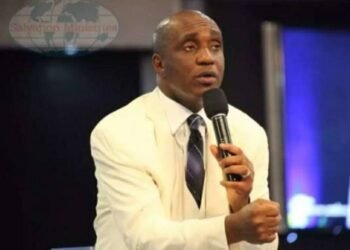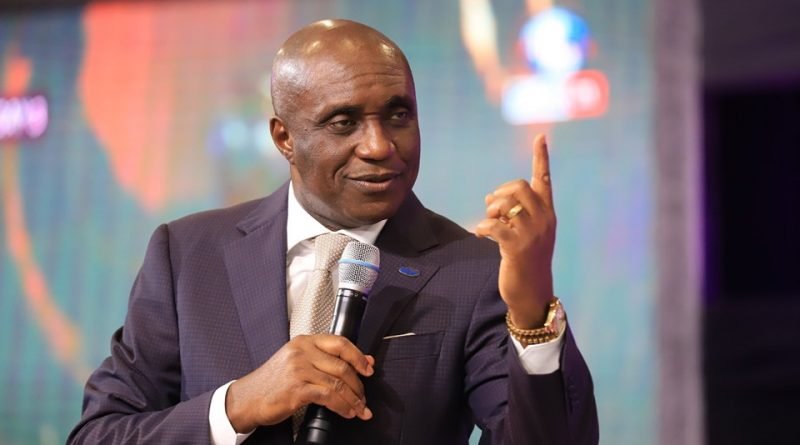
…clips of the Pastor David Ibiyeomie Offering revelation circulated widely on social media.
PORT HARCOURT, NIGERIA — The iNews Times reports that the Pastor David Ibiyeomie Offering revelation has triggered widespread conversation across social media after the founder of Salvation Ministries disclosed the substantial sums he personally gives as church offerings.
During a recent sermon, David Ibiyeomie told his congregation that his minimum offering every Sunday is $12,000, while he gives at least $2,000 on weekdays. The disclosure, now trending online, has drawn mixed reactions from supporters and critics alike, placing the Pastor David Ibiyeomie Offering statement at the centre of public discussion about wealth, faith, and financial sacrifice in Nigerian Christianity.
Addressing worshippers during the sermon, Pastor Ibiyeomie emphasised that his personal wealth is not dependent on contributions from church members.
“The minimum offering I give on Sundays is $12,000, and $2,000 on weekdays,” he declared. “Even if you don’t give me offerings, I will still be stinkingly rich.”
The Pastor David Ibiyeomie Offering comment was framed as a lesson in generosity and financial principles rooted in faith. According to the cleric, consistent giving rather than reliance on others’ donations is key to prosperity.
Explaining his philosophy, Pastor Ibiyeomie used his own financial commitment as a model for congregants. He suggested that sacrificial giving unlocks divine favour and financial increase.
The Pastor David Ibiyeomie Offering disclosure was not presented as a boast, but rather as what he described as practical proof of spiritual principles at work. He urged members to adopt a giving culture, insisting that wealth flows to those who honour God through consistent contributions.
Salvation Ministries, headquartered in Port Harcourt, is one of Nigeria’s prominent Pentecostal churches, with branches across the country and internationally. Founded in 1997, the church has grown significantly over the decades, attracting thousands of worshippers and building expansive facilities.
Observers note that public conversations around clerical wealth are not new in Nigeria, particularly within Pentecostal and charismatic circles where prosperity theology is widely preached. However, the specific figures mentioned in the Pastor David Ibiyeomie Offering statement have amplified scrutiny and online debate.
Following the sermon, clips of the Pastor David Ibiyeomie Offering revelation circulated widely on social media platforms, where Nigerians expressed varied opinions.
Some supporters praised the cleric for transparency and consistency in giving, arguing that his example reinforces the biblical principle of sowing and reaping. Others questioned the optics of publicly announcing such large sums, particularly in a country grappling with economic challenges, inflation, and currency fluctuations.
The conversation reflects broader societal tensions regarding wealth accumulation among religious leaders. Nigeria remains one of the most religious countries globally, with churches playing significant spiritual, social, and economic roles in communities.
Prosperity theology, often associated with teachings that emphasise financial blessings as a reward for faith and generosity, has shaped many contemporary churches in Nigeria. The Pastor David Ibiyeomie Offering statement aligns with this theological perspective, where giving is presented as a spiritual investment.
Critics of prosperity preaching argue that such messages can create unrealistic financial expectations among followers. Supporters, however, contend that disciplined giving encourages responsibility, faith, and economic empowerment.
Pastor Ibiyeomie has consistently taught on wealth creation, entrepreneurship, and faith-based financial discipline. His ministry frequently organises conferences and teachings centred on personal development and spiritual growth.
In many Nigerian churches, offerings constitute a central part of worship services. These financial contributions support church operations, charitable initiatives, infrastructure development, and missionary work.
Large ministries often run schools, humanitarian outreaches, and community programmes funded through donations. While the Pastor David Ibiyeomie Offering statement focused on his personal giving, it also reignited discussion about transparency and accountability in religious institutions.
Financial disclosures by pastors are relatively rare, making this revelation particularly noteworthy.
The Pastor David Ibiyeomie Offering disclosure comes at a time when many Nigerians face economic pressures, including rising living costs and fluctuating exchange rates. The dollar-denominated amounts mentioned during the sermon further intensified reactions, given the local currency’s volatility.
Economic analysts say public sensitivity to displays of wealth has increased in recent years, especially when linked to institutions reliant on voluntary contributions.
Nonetheless, supporters argue that individual prosperity does not negate broader economic challenges, insisting that financial success achieved through entrepreneurship and discipline should not be condemned.
The Pastor David Ibiyeomie Offering revelation underscores the enduring influence of megachurch leaders in Nigeria’s religious and social landscape. It also highlights the evolving role of digital media in shaping public discourse around faith and finance.
Whether viewed as inspiration or controversy, the statement has undeniably amplified conversations about generosity, wealth, and accountability within religious spaces.
The iNews Times will continue to monitor reactions and provide balanced coverage on developments surrounding the Pastor David Ibiyeomie Offering discussion.