…proposed Sokoto-Badagry Superhighway Loan involves a syndicated facility from Deutsche Bank.
ABUJA, NIGERIA — The iNews Times | The Sokoto-Badagry Superhighway Loan has formally entered the legislative stage as President Bola Tinubu requested Senate approval for a $516.3 million syndicated financing arrangement to fund key sections of the ambitious infrastructure project under his administration’s Renewed Hope Agenda.
The request was conveyed in a letter read during plenary by Senate President Godswill Akpabio, seeking authorization in accordance with Sections 16 and 21 of the Debt Management Office (Establishment) Act, 2011.
In the communication to lawmakers, President Tinubu outlined the purpose of the proposed foreign financing arrangement.
“The purpose of this communication is to formally request the resolution of the National Assembly to approve a proposed foreign financing arrangement of a syndicated loan facility of US$516,333,007 for the construction of the Sokoto–Badagry Superhighway Project,” the letter stated.
The President specifically requested legislative approval for both the loan facility and its inclusion in the Federal Government’s existing borrowing plan already endorsed by the National Assembly.
According to the President, the Sokoto–Badagry Superhighway is a flagship infrastructure initiative designed to unlock Nigeria’s northwest–southwest economic corridor.
The highway is projected to stretch approximately 1,000 kilometres, connecting Sokoto State to Lagos State through Kebbi, Niger, Kwara, Oyo, and Ogun states, beginning from Illela in the northwest to Badagry in the southwest.
Tinubu described the project as strategically designed to enhance connectivity across Nigeria’s economic zones.
“The project will enhance north–south connectivity and road safety, reduce logistics costs and travel time, facilitate trade and strengthen food security, and promote national integration,” he stated.
Provisions have also been included for future rail integration and utility corridors, a feature the administration says will ensure long-term infrastructure efficiency and multi-modal transport synergy.
The proposed Sokoto-Badagry Superhighway Loan involves a syndicated facility from Deutsche Bank. The financing is backed by a partial risk guarantee from the Islamic Corporation for the Insurance of Investment and Export Credit (ICIEC), the insurance arm of the Islamic Development Bank.
The loan is structured to run for nine years, including a grace period of up to three years. The interest rate is capped at CME SOFR plus 5.3 percent per annum.
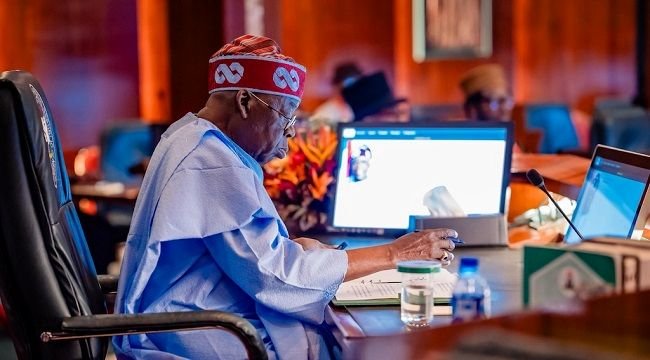
Tinubu noted that the Federal Executive Council has already approved the financing terms before forwarding the request to the Senate.
In addition to the foreign financing component, the Federal Government is expected to provide counterpart funding amounting to ₦265.5 billion to cover land acquisition, compensation, and ancillary infrastructure.
The immediate funding request covers Sections 1, 1A, and 1B of the highway project, spanning approximately 120 kilometres.
Following the presentation of the request, Senate President Akpabio referred the matter to the Senate Committee on Local and Foreign Debts, directing the committee to report back within one week.
The legislative process will determine whether the Sokoto-Badagry Superhighway Loan is formally integrated into Nigeria’s borrowing framework.
During deliberations, Senator Adamu Aliero (Sokoto Central) strongly supported the project, describing it as a long-awaited development that had remained conceptual for decades.
“This project has been on the drawing board for more than five decades, and today it is taking shape,” Aliero said.
He revealed that he had personally inspected segments of the ongoing construction and described the quality as modern and durable.
According to him, the superhighway is being constructed using reinforced concrete and equipped with solar-powered street lighting.
“It meets modern infrastructure standards,” he stated.
Supporters of the Sokoto-Badagry Superhighway Loan argue that the project could significantly reduce travel time between Sokoto and Lagos, from approximately 13 hours to about six hours.
Such a reduction, proponents say, would dramatically cut logistics costs for goods transported between northern agricultural zones and southern commercial hubs.
Agricultural produce from Sokoto, Kebbi, and Niger states could reach Lagos markets faster, potentially lowering post-harvest losses and strengthening food distribution networks.
Akpabio described the initiative as economically transformative.
“This is a major economic game changer capable of saving lives and boosting productivity,” he said.
He defended the Federal Government’s borrowing strategy, emphasizing that infrastructure financing can generate long-term economic value.
“Borrowing for critical infrastructure is justified, particularly where such investments yield long-term benefits and can facilitate repayment through generated value,” Akpabio added.
Nigeria’s public debt profile has remained a subject of national debate, with concerns about rising borrowing levels balanced against the urgent need for infrastructure development.
The Tinubu administration has consistently maintained that strategic borrowing tied to capital projects is essential to close Nigeria’s infrastructure gap, estimated by experts to require trillions of dollars over the coming decades.
The Sokoto-Badagry Superhighway Loan, therefore, sits within a broader fiscal strategy aimed at stimulating economic corridors, improving interstate mobility, and attracting private-sector investment.
However, final approval rests with the Senate after review by the Committee on Local and Foreign Debts.
The committee is expected to submit its report within one week, after which the full Senate will debate and decide on the financing request.
If approved, the loan will accelerate the execution of the first segments of the highway, marking a significant step in what the administration describes as one of its most ambitious infrastructure undertakings.
At The iNews Times, our analysis shows that the outcome of the Senate’s review will not only determine the fate of the Sokoto-Badagry Superhighway Loan but could also shape public perception of the government’s broader borrowing and infrastructure strategy.
As Nigeria balances fiscal prudence with development needs, lawmakers now face a decision that carries economic, political, and long-term national implications.
The iNews Times will continue to provide in-depth coverage as the Senate deliberates on the request and the future of this landmark project unfolds.