…the World Cup 2026 will be jointly hosted by the United States, Mexico and Canada.
WASHINGTON, UNITED STATES — The iNews Times | The build-up to the World Cup 2026 has taken a dramatic diplomatic turn after a special envoy to US President Donald Trump called on FIFA to consider replacing Iran with Italy at the tournament.
According to the Financial Times, Paolo Zampolli confirmed that he had suggested to both President Trump and FIFA President Gianni Infantino that Italy be included in the World Cup 2026 lineup, despite the country’s failure to qualify through the official playoff process.
Zampolli, an Italian native serving as a US envoy, described the idea as a “dream,” noting Italy’s rich football heritage and its four World Cup titles. “With four titles, they have the pedigree to justify inclusion,” he said, expressing hope that the Azzurri could feature at a tournament hosted on American soil.
The World Cup 2026 will be jointly hosted by the United States, Mexico and Canada, marking the first time three countries will co-host the competition. It will also be the first edition expanded to 48 teams, increasing global participation and commercial reach.
Italy’s Absence and Iran’s Qualification
Italy, one of football’s most decorated nations, has endured a historic slump. After winning the tournament in 1934, 1938, 1982 and 2006, the European giants have now failed to qualify for three consecutive editions. Their most recent setback came in a playoff loss to Bosnia and Herzegovina, where they were defeated on penalties.
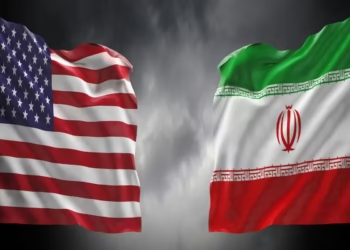
Iran, meanwhile, secured its qualification for the World Cup 2026 on sporting merit. However, its participation has come under heightened scrutiny amid escalating geopolitical tensions involving the United States and Israel. The conflict, which intensified in late February, has added diplomatic sensitivity to an already complex international tournament.
Reports indicate that the Iranian Football Federation previously explored discussions with FIFA about possibly relocating its matches from the United States to Mexico due to political concerns.
Despite the growing conversation, Infantino has publicly maintained that Iran will participate according to the official draw, reinforcing FIFA’s stance that qualification outcomes remain governed by established sporting regulations.
The suggestion tied to the World Cup 2026 has sparked debate about the boundaries between politics and sport. Historically, FIFA has positioned itself as an organization committed to neutrality, although geopolitical tensions have occasionally affected tournament participation.
Analysts note that altering the World Cup 2026 lineup outside competitive qualification could trigger legal disputes, diplomatic backlash, and questions about FIFA’s credibility. Qualification tournaments are structured under strict regulatory frameworks, and any deviation would likely require extraordinary justification.
The Financial Times report also suggested that the proposal may carry diplomatic undertones. Observers pointed to strained relations between President Trump and Italian Prime Minister Giorgia Meloni, following disagreements related to the Iran conflict. Some analysts speculate that including Italy in the World Cup 2026 could serve as a symbolic gesture to strengthen US–Italy ties.
From a commercial standpoint, Italy’s presence at the World Cup 2026 would undoubtedly boost global viewership, sponsorship interest, and fan engagement. Italy remains one of football’s most marketable brands, with a passionate global following.
However, critics argue that commercial considerations cannot override sporting fairness. Iran qualified through competitive play, while Italy did not. Removing a team that earned its place could set a controversial precedent.
The World Cup 2026 is already historic due to its expanded format and North American hosting arrangement. Any major change to qualified teams would risk overshadowing preparations and shifting focus away from football itself.
As preparations intensify, FIFA has not indicated any intention to modify the qualified list of teams. Infantino’s previous remarks suggest the governing body intends to adhere to the official draw and qualification outcomes.
For now, the debate surrounding the World Cup 2026 remains speculative. No formal proceedings have been announced regarding Iran’s status or Italy’s potential inclusion.
At The iNews Times, our analysis indicates that unless significant political or regulatory developments occur, FIFA is unlikely to deviate from its established qualification framework.
Yet the controversy highlights how global sporting events increasingly intersect with international diplomacy, security considerations, and strategic alliances.
With the World Cup 2026 set to become the largest edition in history, the coming months will test FIFA’s ability to balance neutrality, commercial interests, and geopolitical realities.
The iNews Times will continue monitoring developments as the road to the World Cup 2026 unfolds.