…the APGA presidential candidate debate will become a central issue after the 2027 elections.
AWKA, Nigeria — The iNews Times | The APGA presidential candidate debate has resurfaced ahead of the 2027 general elections, as the All Progressives Grand Alliance’s National Vice Chairman for the South East, Pastor Augustine Ihemere, openly criticised the party’s long-standing decision not to field a presidential candidate, warning that the policy is slowing the party’s growth.
Speaking in Awka, Anambra State, Ihemere expressed concern that APGA’s repeated absence from the presidential ballot has weakened its negotiating strength nationally and limited its expansion, particularly in the South East geopolitical zone where the party traditionally enjoys significant grassroots support.
According to him, the APGA presidential candidate debate will become a central issue after the 2027 elections, as party leaders are expected to review the strategy and determine whether continuing without a presidential flag bearer serves the long-term interests of the party.
He argued that while APGA has maintained strong regional relevance, its refusal to contest at the highest level of national politics sends a signal that the party is unwilling to compete for executive power at the federal level. Such a posture, he warned, may affect public perception and discourage broader national alignment.
The APGA presidential candidate debate comes at a time when political realignments are intensifying across Nigeria in preparation for 2027. Political analysts note that presidential elections often shape voter behaviour down-ballot, influencing support for governorship, senatorial and House of Representatives candidates. Without a presidential contender, a party may struggle to sustain momentum beyond its core strongholds.
Ihemere urged South East voters to rally behind APGA candidates in the forthcoming elections, cautioning against what he described as a repeat of the 2023 general election scenario. In 2023, a significant number of South East voters shifted support to the Labour Party due largely to its presidential candidate, a development that altered electoral outcomes in the region.
He advised the electorate to prioritise regional political consolidation by strengthening APGA across all elective positions, including governorship and legislative seats. According to him, the South East requires a cohesive political platform through which it can negotiate influence at the national level.
The APGA presidential candidate debate also intersected with broader commentary on the opposition landscape. Ihemere predicted that Peter Obi might not eventually emerge as the presidential candidate of the African Democratic Congress, citing internal leadership tensions within the party. He further alleged that incumbency powers at the federal level could complicate potential candidacy moves ahead of 2027.
While those claims remain speculative, the statement underscores the fluid nature of Nigeria’s pre-election political environment, where party alliances, internal disputes and strategic positioning frequently reshape the field months before primaries begin.
Observers say the conversation about whether APGA should field a presidential candidate is not new. Historically, APGA has concentrated on consolidating power within Anambra State and maintaining a regional footprint rather than mounting expansive national campaigns. However, as voter expectations evolve and political competition intensifies, internal calls for a more ambitious national posture appear to be growing.
Ihemere described APGA as the most viable political platform for the South East, insisting that the region must use a unified structure to negotiate equitable representation within Nigeria’s power dynamics. In his view, dispersing votes across multiple national platforms may weaken the bargaining position of the zone.
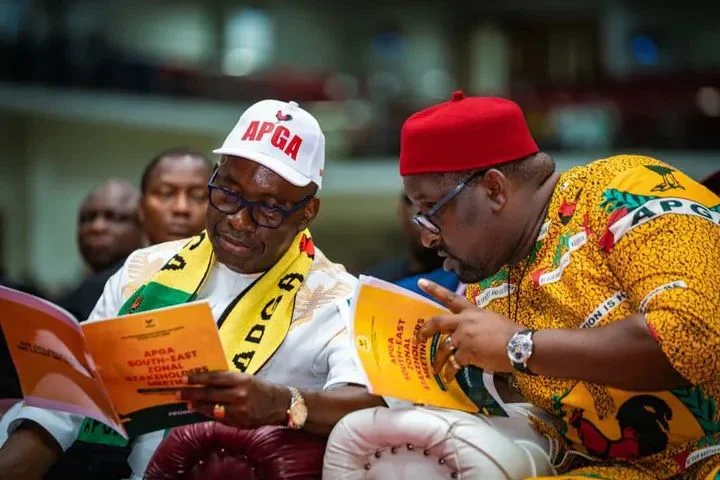
The meeting of APGA South East stakeholders in Awka, which he convened over the weekend, was aimed at charting a strategic course for the 2027 elections. According to him, party leaders gathered to brainstorm on how to consolidate the zone and expand APGA’s electoral reach.
Political observers note that zoning, alliances and candidate selection strategies will be decisive in 2027. For APGA, the internal discussion over whether to join the presidential race could redefine the party’s identity and electoral strategy for years to come.
The APGA presidential candidate debate is therefore more than a tactical disagreement; it reflects deeper questions about the party’s future direction, national ambition and relevance in an increasingly competitive political arena.
As Nigeria approaches another electoral cycle, parties are reassessing structures, messaging and coalition-building strategies. Whether APGA ultimately revises its policy or maintains its traditional approach remains to be seen. However, the public airing of concerns by a senior party figure signals that the issue is unlikely to fade quietly.
The iNews Times will continue to monitor developments within APGA and across Nigeria’s evolving political landscape as preparations for the 2027 general elections gather momentum.