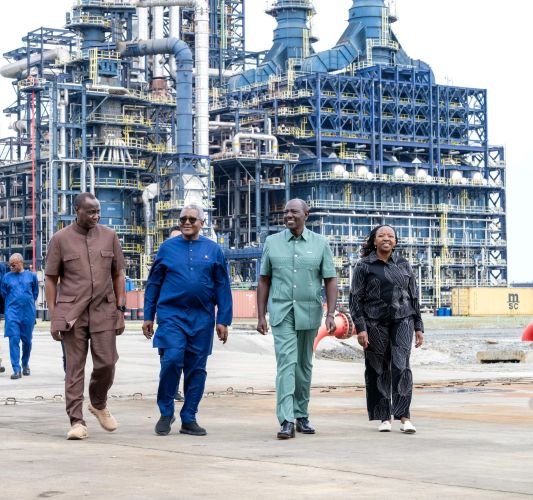
Dangote Refinery in Lamu Faces Court Halt as Locals Challenge Evictions.
Kenyan Judge Orders Status Quo Maintained Until October Hearing, Casting Shadow Over Planned Groundbreaking.
LAMU, KENYA — The iNews Times | A Kenyan court has ordered a temporary halt to construction activities linked to the proposed Dangote refinery in Lamu, following complaints from local farmers and residents who say they face forceful eviction and property destruction without proper resettlement plans.
The Malindi Environment and Land Court, under Judge Jane Onyango, directed that the status quo be maintained after petitioners from Chandavai in Lamu County challenged the project. The order, issued on 25 September and made public this week, means further directions will come on 14 October. The development has introduced fresh uncertainty around the ambitious 700,000-barrel-per-day facility planned by Africa’s richest man, Aliko Dangote, just days before a scheduled groundbreaking.
In this report, we examine the key developments, reactions from stakeholders, and the broader implications.
Background of the Story
The proposed Dangote refinery in Lamu forms a central part of Kenya’s push to expand regional energy infrastructure and reduce reliance on imported petroleum products. President William Ruto has publicly backed the venture, describing it as a regional project expected to boost industrial activity across East Africa, create jobs and build technical skills. During a recent visit to the existing Dangote Petroleum Refinery in Lekki, Lagos, Ruto stated that his government had already secured land for the Lamu site and was accelerating administrative processes to remove bureaucratic delays.
Dangote Group https://www.dangote.com has indicated the new plant would exceed the capacity of its Nigerian facility. The project is positioned as a major private-sector investment capable of transforming Kenya’s downstream oil sector and serving neighbouring markets. However, large-scale industrial projects in coastal Kenya have long attracted scrutiny over land rights, environmental safeguards and community consultation, issues that have now brought the scheme into court.
Key Developments
On 25 September, Judge Jane Onyango of the Malindi Environment and Land Court ruled that the status quo must be preserved pending further hearing. Petitioners, including farmers and residents of Chandavai, argued that the project involves forceful eviction, damage to properties and the absence of a resettlement plan. They further claimed that neither Dangote nor Kenyan authorities had completed a mandatory environmental impact assessment required under national environmental law, nor conducted the public participation mandated by Kenya’s constitution.
Lawyer George Wakahiu, representing the petitioners, confirmed that the ruling prevents construction from beginning until the court reconvenes on 14 October. The order does not explicitly cancel the planned groundbreaking ceremony, yet it restricts activities at the site while the case proceeds.
Dangote Group responded in a statement that the court has not halted the groundbreaking at this stage. The company noted, however, that activities at the proposed refinery site may be affected because both parties are required to refrain from actions that alter the current situation until the October hearing.
Reactions from Stakeholders
President Ruto has continued to express strong support for the project, emphasising its potential to expand industrial capacity and employment in the region. Officials have framed the refinery as a strategic national priority that will strengthen Kenya’s energy security and position the country as a petroleum hub for East Africa.
Local petitioners and their counsel maintain that constitutional and environmental requirements have not been met. They argue that proceeding without adequate consultation and impact assessment risks irreversible harm to livelihoods and the coastal environment. Dangote Group has limited its public comments to clarifying the precise scope of the court order, stressing that the groundbreaking itself has not been stopped while acknowledging possible restrictions on site activities.
Implications
The court intervention carries significant weight for both Kenya’s investment climate and Dangote’s regional expansion. A prolonged legal dispute could delay construction timelines, raise costs and test the government’s ability to balance large-scale foreign investment with community rights and environmental compliance. For Lamu County, the project promises substantial economic activity, yet unresolved land and resettlement questions risk generating lasting social tension.
At a broader level, the case highlights recurring tensions across East Africa between infrastructure ambitions and the legal protections afforded to local communities. How Kenyan authorities and the investor respond in the coming weeks will influence perceptions of regulatory predictability and the ease of doing business in the energy sector.
What Happens Next
The Malindi court is scheduled to provide further directions on 14 October. Until then, both parties are expected to maintain the status quo. The Kenyan government has indicated it is fast-tracking remaining administrative processes, while Dangote Group continues preparations for the facility. Observers will watch closely whether the October hearing produces interim relief for the petitioners, clears the path for construction, or leads to additional conditions around environmental assessment and resettlement.
Conclusion
The temporary court order on the Dangote refinery in Lamu underscores the complex intersection of investment, land rights and environmental governance in Kenya. While the project holds clear potential to reshape regional energy markets and create employment, the legal challenge from Chandavai residents has forced a pause that cannot be ignored. How the parties navigate the 14 October hearing will determine whether the ambitious refinery moves forward smoothly or faces extended delays. The iNews Times will continue to track developments as this significant East African energy story unfolds.